






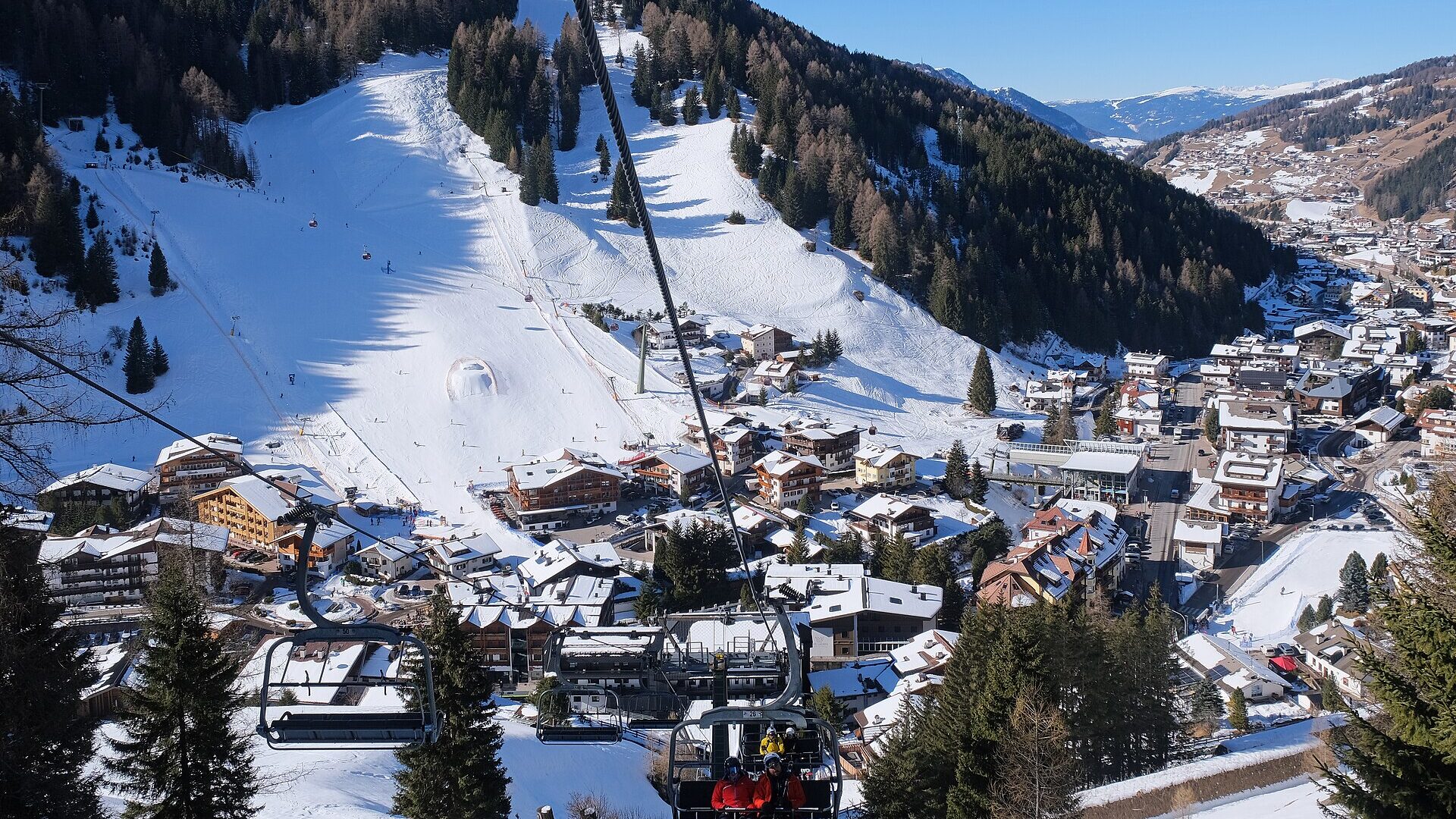

The biggest ski area reachable from an Italian resort is Via Lattea, with 400 km of slopes and 71 lifts, followed by Cervinia at 322 km, a figure it shares with Zermatt in Switzerland. After those two the field drops sharply: Val Gardena is third at 175 km, then La Thuile (160 km), Madonna di Campiglio (150 km) and Alta Badia (130 km). Ten distinct areas reach 110 km or more in our data. Most are intermediate-heavy, and day passes run from €58.50 to €85, depending on season label and scope.
Key takeaways
- Via Lattea is the largest area in Italy at 400 km and 71 lifts, with a €58.50 (2026/27) day pass that works out at €0.15 per km.
- Cervinia’s 322 km crosses the border into Switzerland; the €63 (2026/27) pass in our data covers the Italian side only.
- Val Gardena has the most lifts of the ten, 79, or 2.2 km of piste per lift.
- Alta Badia is the easiest of the ten with 57% of its 130 km graded easy; Kronplatz has the highest expert share of the ten where a split exists, at 24%.
- Courmayeur and Val di Fiemme have no difficulty split in our data, so they are left out of every percentage below.
The 10 biggest ski areas in Italy, side by side
We ranked distinct ski areas, not villages. Where several villages sit in one linked area they carry the same total slope kilometres, so we count the area once and list its base villages. The table uses the first-listed village of each area for base elevation.
| Resort | Slopes | Easy / intermediate / expert | Lifts | Base | Top | Adult day pass | Pass scope |
|---|---|---|---|---|---|---|---|
| Sestriere (Via Lattea) | 400 km | 96 / 220 / 84 km | 71 | 2,035 m | 2,823 m | €58.50 (2026/27) | Whole area |
| Cervinia (with Zermatt) | 322 km | 75 / 220 / 27 km | 52 | 2,050 m | 3,883 m | €63 (2026/27) | Italian side only |
| Selva Val Gardena (Val Gardena) | 175 km | 50 / 104 / 21 km | 79 | 1,563 m | 2,518 m | €72 (2025/26) | Valley area |
| La Thuile (with La Rosière) | 160 km | 63 / 79 / 18 km | 38 | 1,441 m | 2,641 m | €61 (2026/27) | Whole area |
| Madonna di Campiglio (Campiglio) | 150 km | 48 / 70 / 32 km | 60 | 1,520 m | 2,504 m | €85 (2025/26) | Whole area |
| Corvara (Alta Badia) | 130 km | 74 / 47 / 9 km | 53 | 1,568 m | 2,778 m | €80 (2025/26) | Valley area |
| Cortina d’Ampezzo | 120 km | 46 / 59 / 15 km | 36 | 1,224 m | 3,269 m | €80 (2025/26) | Local |
| Kronplatz | 119 km | 57 / 34 / 28 km | 32 | 930 m | 2,275 m | €83 (2026/27) | Local |
| Livigno | 115 km | 32 / 63 / 20 km | 31 | 1,816 m | 2,798 m | €74.50 (2026/27) | Local |
| Val di Fiemme | 110 km | Not in our data | 50 | 960 m | 2,440 m | €71 (2025/26) | Network bundle |
Source: Intski resort database (lift pass index), checked November 2026, 258 resorts. Prices carry their season: 2025/26 and 2026/27 prices are not directly comparable.
Which is the biggest ski area in Italy?
Via Lattea is the biggest ski area in Italy in our database of 258 resorts: 400 km of slopes and 71 lifts, in Piedmont, reached from Sestriere and Sauze d’Oulx. Both villages show identical area figures, so the difference between them is altitude. Sestriere’s base is 2,035 m and Sauze d’Oulx’s is 1,509 m, with the same 2,823 m top. Via Lattea splits 96 km easy, 220 km intermediate and 84 km expert, which is 55% intermediate.
It is also cheap for its size. The Vialattea Italia day pass is €58.50 for 2026/27, covering 400 km, or about €0.15 per km. In our data that is the lowest price per km of any of the ten. Its 71 lifts give 5.6 km of piste per lift, the second-thinnest lift network of the ten after Cervinia (6.2 km), so expect more length per lift than in the Dolomites.
Is Cervinia really bigger than Zermatt?
Not on its own. Cervinia is listed at 322 km, but that is the Matterhorn ski paradise as a whole, shared with Zermatt in Switzerland. The Italian side alone is a smaller number, and our data does not break it out. What we do hold is the pass: the Breuil-Cervinia and Valtournenche day pass costs €63 (2026/27) and is valid on the Italian side only.
The terrain is the draw. Cervinia climbs from 2,050 m to 3,883 m, a vertical of 1,833 m, and 68% of the 322 km is intermediate. Only 27 km, 8%, is graded expert. Our Cervinia vs Zermatt comparison covers which side to book.
How do Val Gardena and Alta Badia rank against the bigger areas?
In our data Selva Val Gardena is the third-biggest area at 175 km, and Corvara is sixth at 130 km. These are valley ski areas, and both sit on the Sella Ronda, the circuit that links Val Gardena, Alta Badia, Arabba and the Fassa valley on skis. Both also belong to Dolomiti Superski, a pass network far larger than either valley. Our data does not give a network kilometre figure for it, so we do not quote one. The ranking is by valley area, and the Sella Ronda means neither valley is a closed box.
The villages in Val Gardena are Selva, Ortisei and the Val Gardena listing. All three show 175 km and 79 lifts, which is 2.2 km of piste per lift, one of the densest networks in the table. Base elevation differs: Selva is at 1,563 m, Ortisei and the Val Gardena listing at 1,236 m. The local pass costs €72 (2025/26), or €0.41 per km.
Alta Badia’s villages are Corvara, La Villa and Alta Badia. All show 130 km and 53 lifts, topping out at 2,778 m. The base sits at 1,568 m in Corvara, 1,433 m in La Villa and 1,324 m in the Alta Badia listing. The terrain is the gentlest of the ten: 74 km easy, 47 km intermediate and 9 km expert, so 57% is easy. The local day pass is €80 (2025/26), or €0.62 per km. For a head-to-head, see Val Gardena vs Alta Badia.
Which Italian areas are shared with another country?
Two of the top ten cross a border, and both figures include foreign terrain. Cervinia is joined to Zermatt, as above. La Thuile is the Italian half of Espace San Bernardo, which is linked to La Rosière in France. Its 160 km is the whole joined area, not the Italian slopes alone. The pass in our data is €61 (2026/27) and covers 152 km, slightly less than the full 160 km.
La Thuile splits 63 km easy, 79 km intermediate and 18 km expert, 39% easy and 11% expert. It has only 38 lifts, or 4.2 km per lift, so it is a less dense network than Val Gardena. The base is 1,441 m and the top 2,641 m.
Madonna di Campiglio: one area, three bases
The Skiarea Campiglio Dolomiti di Brenta is listed at 150 km under Madonna di Campiglio, Folgarida and Val di Sole. The area total and the difficulty split (48 km easy, 70 km intermediate, 32 km expert) are the same on all three. The village rows are not identical in every field: Madonna di Campiglio and Folgarida show 60 lifts, while Val di Sole shows 36, a base of 1,400 m and a top of 2,846 m. Madonna di Campiglio’s own sector is 60 km and Folgarida’s is 63 km.
The pass is the most expensive in the table: €85 (2025/26) for Madonna di Campiglio and Folgarida, covering 156 km, or €0.54 per km. Val di Sole is listed with the Superskirama pass at €83.5 (2025/26). Pinzolo belongs to the same wider area but is listed separately at 70 km with a €60 (2026/27) pass for 30 km. Expert terrain is 21% of the area, a higher share than at Alta Badia (7%) or Cervinia (8%).
Cortina, Kronplatz, Livigno and Val di Fiemme at 110 to 120 km
The last four places are close. Cortina d’Ampezzo has 120 km but a vertical of 2,045 m, from 1,224 m to 3,269 m, the largest of the ten, ahead of Cervinia’s 1,833 m. Kronplatz has 119 km on 32 lifts and the highest expert share of the ten where a split exists: 28 km, 24%. It also has a low base of 930 m. Livigno has 115 km at a high base of 1,816 m, and its 63 km of intermediate terrain makes up 55% of the area.
Val di Fiemme needs care. Its own sector is 23 km in our data, and the 110 km figure comes from the Val di Fiemme-Obereggen bundle pass, which is network scope. There is no easy, intermediate or expert split. It is on the list because the bundle covers 110 km, but it is not a single connected 110 km area in the way Via Lattea is. Three more resorts sit at 100 km and just miss the cut: Courmayeur, Bardonecchia and Passo Tonale. Courmayeur has no difficulty split in our data either.
Which big Italian area suits which skier?
- Beginners and families: Alta Badia (57% easy, 74 km) and Kronplatz (48% easy). See family resorts in Italy.
- Intermediates who want distance: Via Lattea (220 km of intermediate terrain) and Cervinia (220 km). Our guide to Italian resorts for intermediates goes further.
- Strong skiers: Kronplatz (24% expert), Madonna di Campiglio (21%) and Via Lattea (84 km, the largest absolute expert total of the ten).
- Budget: Via Lattea at €0.15 per km (2026/27), La Thuile at €0.40 (2026/27) and Val Gardena at €0.41 (2025/26).
What the numbers do not show
Slope kilometres are as published by the resorts, and areas are measured differently. A linked area, a valley area and a pass network are not the same thing. Prices mix two seasons, 2025/26 and 2026/27, so a €85 pass at Madonna di Campiglio is not directly comparable with a €58.50 pass at Via Lattea. We have no snowfall, queue or lift-quality data in this table. Airport distances in our data are straight-line: Sestriere is about 66 km from Turin and Cervinia about 82 km from Turin as the crow flies.
To compare any two of these areas, use the compare tool, check announced opening dates before you book, and work out a full week with the ski trip cost calculator. For airport access, see ski resorts near Turin and near Milan.
Quick answers
What is the biggest ski area in Italy?
Via Lattea, with 400 km of slopes and 71 lifts in our data. Cervinia is second at 322 km, but that figure is shared with Zermatt in Switzerland. The Via Lattea day pass is €58.50 for 2026/27.
How many km of slopes does Cervinia have?
322 km, the whole Matterhorn ski paradise shared with Zermatt. The Italian-side pass in our data costs €63 for 2026/27 and covers only the Italian side. Cervinia has 52 lifts, a base of 2,050 m and a top of 3,883 m.
How big is Val Gardena compared with Alta Badia?
Val Gardena has 175 km and 79 lifts, Alta Badia 130 km and 53 lifts, both as valley areas. They connect on the Sella Ronda and sit in Dolomiti Superski, whose wider network kilometres are not in our data. Local passes are €72 and €80 (both 2025/26).
Which big Italian ski area is best for beginners?
Alta Badia in our data. 74 km of its 130 km, 57%, is graded easy, the highest easy share of the ten. Kronplatz is next with 57 km easy of 119 km, 48%. Alta Badia’s local pass is €80 (2025/26).
Which big Italian ski area has the most expert terrain?
Via Lattea has the most in kilometres, 84 km of 400 km. Kronplatz has the highest share, 24% (28 km of 119 km), among the ten areas with a split. Courmayeur and Val di Fiemme have no split in our data.
Which big Italian ski area is cheapest per km?
Via Lattea: €58.50 for 400 km, about €0.15 per km (2026/27). La Thuile is about €0.40 (€61 for 152 km, 2026/27). Val Gardena is about €0.41 (€72 for 175 km, 2025/26). Different seasons, so treat the gaps as indicative.
Is La Thuile entirely in Italy?
No. Its 160 km is Espace San Bernardo, linked to La Rosière in France. The pass in our data costs €61 for 2026/27 and covers 152 km. La Thuile’s own base is 1,441 m and its top 2,641 m.