
Val Gardena and Alta Badia are the two best-known valleys on the Sella Ronda, the lift-linked circuit around the Sella massif in the Dolomites, and both sell the Dolomiti Superski pass that opens the whole region. The choice between them is about the home sector and the village. Val Gardena has the bigger local area, 175 km on 79 lifts, a mountain that leans intermediate with 59% red runs, two snow parks and a €72 local pass. Alta Badia has 130 km on 53 lifts, the gentlest profile in the Dolomites with 57% easy terrain, a higher top station at 2,778 m, Michelin-starred mountain huts and an €80 local pass. Choose Val Gardena for mileage, parks and the livelier villages; choose Alta Badia for beginners, families, food and a quieter week.
Key takeaways
- Val Gardena (own sector): 175 km, 79 lifts, 50 km easy / 104 km intermediate / 21 km expert (29 / 59 / 12%), 1,236 to 2,518 m, two snow parks, local day pass €72.
- Alta Badia (own sector): 130 km, 53 lifts, 74 km easy / 47 km intermediate / 9 km expert (57 / 36 / 7%), 1,324 to 2,778 m, local day pass €80.
- Both are on the Sella Ronda and the Dolomiti Superski pass (€89 a day), which links 16 resorts and 11 ski areas in our data with a top at 3,269 m on the Marmolada.
- Both run December to April and both host December World Cup races: the Saslong downhill in Val Gardena, the Gran Risa giant slalom in Alta Badia.
- Villages: Ortisei (1,236 m), Santa Cristina and Selva (1,563 m) in Val Gardena; Corvara (1,568 m), La Villa (1,433 m), San Cassiano, Badia and Colfosco in Alta Badia.
Val Gardena vs Alta Badia: the numbers side by side
| Val Gardena | Alta Badia | |
|---|---|---|
| Own sector | 175 km | 130 km |
| Easy / intermediate / expert | 50 / 104 / 21 km (29 / 59 / 12%) | 74 / 47 / 9 km (57 / 36 / 7%) |
| Lifts | 79 | 53 |
| Km of piste per lift | 2.2 km | 2.5 km |
| Base to top | 1,236 to 2,518 m | 1,324 to 2,778 m |
| Vertical drop | 1,282 m | 1,454 m |
| Snow parks | 2 | none listed |
| Season (our data) | December to April | December to April |
| Local adult day pass | €72 (2025/26) | €80 (2025/26) |
| Dolomiti Superski day pass | €89 | €89 |
| Main villages and altitude | Ortisei 1,236 m, Santa Cristina 1,428 m, Selva 1,563 m | Corvara 1,568 m, Colfosco 1,645 m, La Villa 1,433 m, San Cassiano 1,537 m, Badia 1,324 m |
| Nearest airport in our data | Bolzano, about 31 km | Bolzano, about 43 km |
| Intski flags | Stunning views, top facilities, traditional charm | Traditional charm, stunning views |
| Tags | Sella Ronda, Dolomites, wood carving, Ladin culture | Gourmet, Sella Ronda, Dolomites, Ladin culture |
| Rank in Italy by size | 6th of 30 | 13th of 30 |
Source: Intski resort database, Dolomiti Superski ski area page and lift pass index, checked 14 September 2026. Slope figures are each valley’s own sector before you ride into the rest of the network; difficulty shares from skiresort.info. Village altitudes are the base of the lifts at that village.
One circuit, two home sectors
The Sella Ronda is a 40 km lift-and-piste loop around the Sella massif through four valleys: Val Gardena, Alta Badia, Arabba and Val di Fassa. Both valleys in this comparison are on it, so a skier based in Selva and one based in Corvara can ski the same circuit in a day and meet for lunch. The Dolomiti Superski pass, €89 a day in our index, covers the circuit and 11 further ski areas across the region, 16 resorts in our data from Cortina to Kronplatz and the Val di Fiemme. Our ski area page compares all 16 villages.
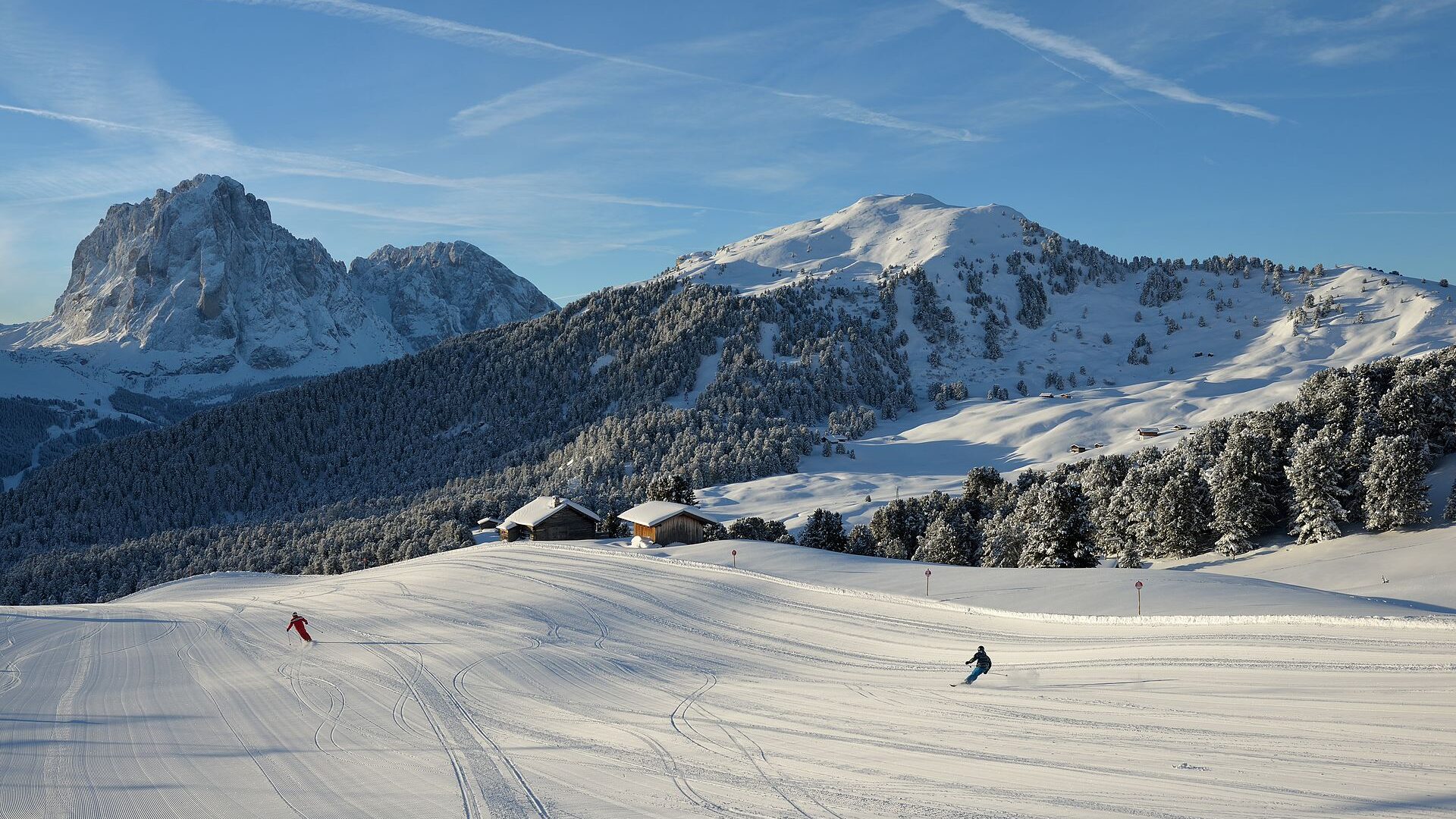
What you buy with the local pass, and what you ski on a lazy day, is the home sector. Val Gardena’s is the biggest in the Dolomites in our data at 175 km, spread over the Seceda and Alpe di Siusi sides above Ortisei and the Ciampinoi and Dantercepies sides above Selva, with 79 lifts, one for every 2.2 km of piste, and two snow parks. Alta Badia’s 130 km lies on the broad, sunny plateau between Corvara, La Villa, San Cassiano and Colfosco, on 53 lifts, with the Piz La Ila and Pralongià meadows at its heart. Our guide to reading slope statistics explains why the own-sector figure is the one to compare.
The terrain: red runs against blue meadows
Val Gardena’s split is 29% easy, 59% intermediate and 12% expert, the profile of a cruising mountain for confident skiers. The Saslong, the World Cup downhill above Santa Cristina, and the long Ciampinoi runs into Selva are proper reds; the Seceda side has the scenery and the length, with a 10 km descent to Ortisei; the Alpe di Siusi is the gentle, open plateau for beginners. Two snow parks make it the freestyle choice of the two.
Alta Badia’s split is 57% easy, 36% intermediate and 7% expert, the gentlest big-area profile in the Dolomites and among the highest easy shares in Italy in our data. The Pralongià plateau is wide, sunny and almost entirely blue, which is why Alta Badia is the Dolomites’ family valley, and the Gran Risa giant slalom piste into La Villa is the one famous steep run. Experts in either valley look to Arabba and the Marmolada, the steep, north-facing corner of the circuit, rather than to the home sector.
Altitude, snow and the villages
Alta Badia has the altitude advantage: a top station at 2,778 m against Val Gardena’s 2,518 m, a 1,454 m vertical against 1,282 m, and villages at 1,433 to 1,645 m against Ortisei’s 1,236 m. Neither carries a snow-sure flag in our data, and the Dolomites rely heavily on snowmaking; the whole Superski region is famous for its grooming. In a lean December, Alta Badia’s higher plateau and Selva at 1,563 m hold snow better than Ortisei. Both valleys run December to April. Our guide to why altitude matters for snow explains the thresholds.
The villages decide the holiday. Val Gardena speaks Ladin, German and Italian and goes by three names, Gherdëina, Gröden and Gardena. Ortisei is the town, with a pedestrian centre, woodcarving workshops and the valley’s shops and nightlife, but its base is the lowest and its lifts are a gondola ride from the main circuit. Selva is the Sella Ronda village, highest and best placed for skiing, and the liveliest of the three for après. Santa Cristina sits between them under the Saslong. Alta Badia’s villages are smaller and quieter: Corvara is the hub at the foot of the Sella, La Villa has the World Cup piste and the most hotels, San Cassiano is the gourmet village with two Michelin-starred restaurants, Colfosco the highest and quietest. Alta Badia carries the gourmet tag in our data for a reason; its mountain huts run a chef’s programme every winter.
Price
Val Gardena’s local day pass is €72, Alta Badia’s €80, both 2025/26 rates and both at or above Italy’s median of €72. The Dolomiti Superski pass is €89 for either, and almost everyone staying a week buys it: for €17 a day over the Alta Badia local pass, or €9 over Val Gardena’s, it opens 11 ski areas. Accommodation follows the valley’s character: Alta Badia’s San Cassiano and Corvara are among the most expensive villages in the Dolomites, Ortisei and Santa Cristina among the better value. Run both through the ski trip cost calculator.
Getting there
Bolzano is the nearest airport in our data, 31 km from Val Gardena and 43 km from Alta Badia as the crow flies, but it has few flights. In practice the Dolomites are reached from Innsbruck (about two hours by road to either valley via the Brenner), Verona (two and a half hours), Venice (three hours) or Munich (three and a half). Val Gardena is the easier of the two: 30 minutes from the Brenner motorway at Chiusa. Alta Badia is a further 30 to 45 minutes over the Gardena pass or via Brunico. Both have winter transfer buses from Innsbruck, Verona and Venice. Official sites: Val Gardena and Alta Badia.
The verdict by skier type
- Beginners and cautious intermediates: Alta Badia. 57% easy terrain on a sunny plateau, from the door in Corvara or La Villa.
- Confident intermediates who want mileage: Val Gardena. 104 km of red runs in the home sector and the Seceda and Ciampinoi descents.
- Families: Alta Badia for the terrain and the calm; Val Gardena from Selva if the children already ski. Our family ski holiday guide has the checklist.
- Freestyle: Val Gardena, the only one of the two with snow parks in our data.
- Experts: either, with the Superski pass and a day in Arabba; Val Gardena’s 21 km of black runs edge Alta Badia’s 9 km at home.
- Food: Alta Badia, without question.
- Après-ski and a town: Val Gardena, Selva for the slopes and Ortisei for the evening.
- Snow in a lean year: Alta Badia’s higher plateau, or Selva over Ortisei within Val Gardena.
- Value: Val Gardena, €8 a day cheaper on the local pass and cheaper to sleep in.
Put them side by side in the compare tool. For the rest of the circuit, the Dolomiti Superski page compares Arabba, Canazei and the other 12 villages.
Still undecided? Set a snow alert on both resort pages and book the valley that gets the first big dump.
Quick answers
Is Val Gardena or Alta Badia better for beginners?
Alta Badia. 74 km of its 130 km home sector is graded easy, 57%, mostly on the wide Pralongià plateau above Corvara and La Villa. Val Gardena is 29% easy, with its gentle terrain concentrated on the Alpe di Siusi.
Which is bigger, Val Gardena or Alta Badia?
Val Gardena, with 175 km of slopes on 79 lifts in its own sector, the largest in the Dolomiti Superski in our data. Alta Badia has 130 km on 53 lifts. Both are on the Sella Ronda and share the Superski pass.
Are Val Gardena and Alta Badia connected?
Yes. Both are on the Sella Ronda, the lift-linked circuit around the Sella massif, and the Dolomiti Superski pass covers both plus the rest of the region. Selva in Val Gardena connects to Colfosco and Corvara in Alta Badia over the Dantercepies lift.
Which is cheaper, Val Gardena or Alta Badia?
Val Gardena. Its local day pass is €72 against Alta Badia’s €80, and Ortisei and Santa Cristina are cheaper to stay in than Corvara or San Cassiano. The Dolomiti Superski pass costs €89 in either valley.
Which village is best for the Sella Ronda?
Selva Val Gardena or Corvara. Both sit directly on the circuit at about 1,565 m, so you can start the Sella Ronda from the village lift in either direction. Ortisei needs a gondola ride to reach it.
Where are the best mountain restaurants, Val Gardena or Alta Badia?
Alta Badia. It carries the gourmet tag in our data, San Cassiano has two Michelin-starred restaurants and the valley’s huts run an annual chef’s programme. Val Gardena’s huts are good but less celebrated.