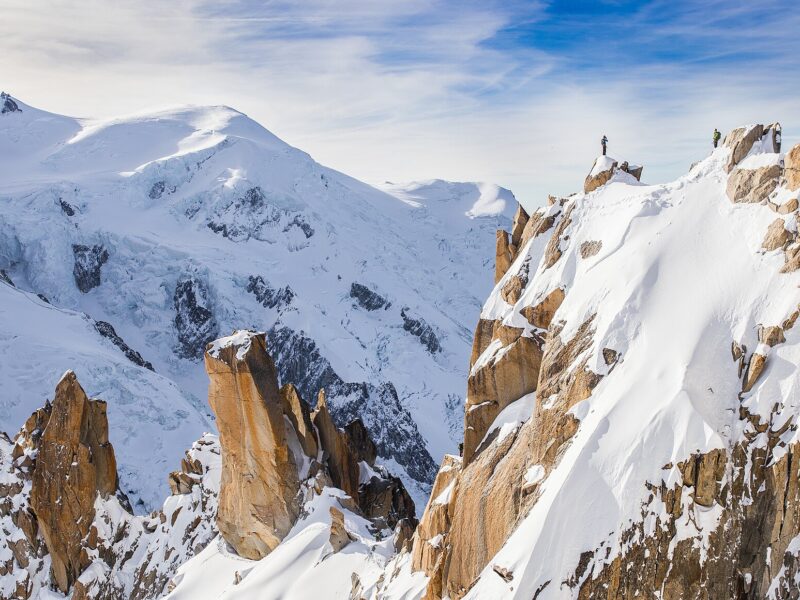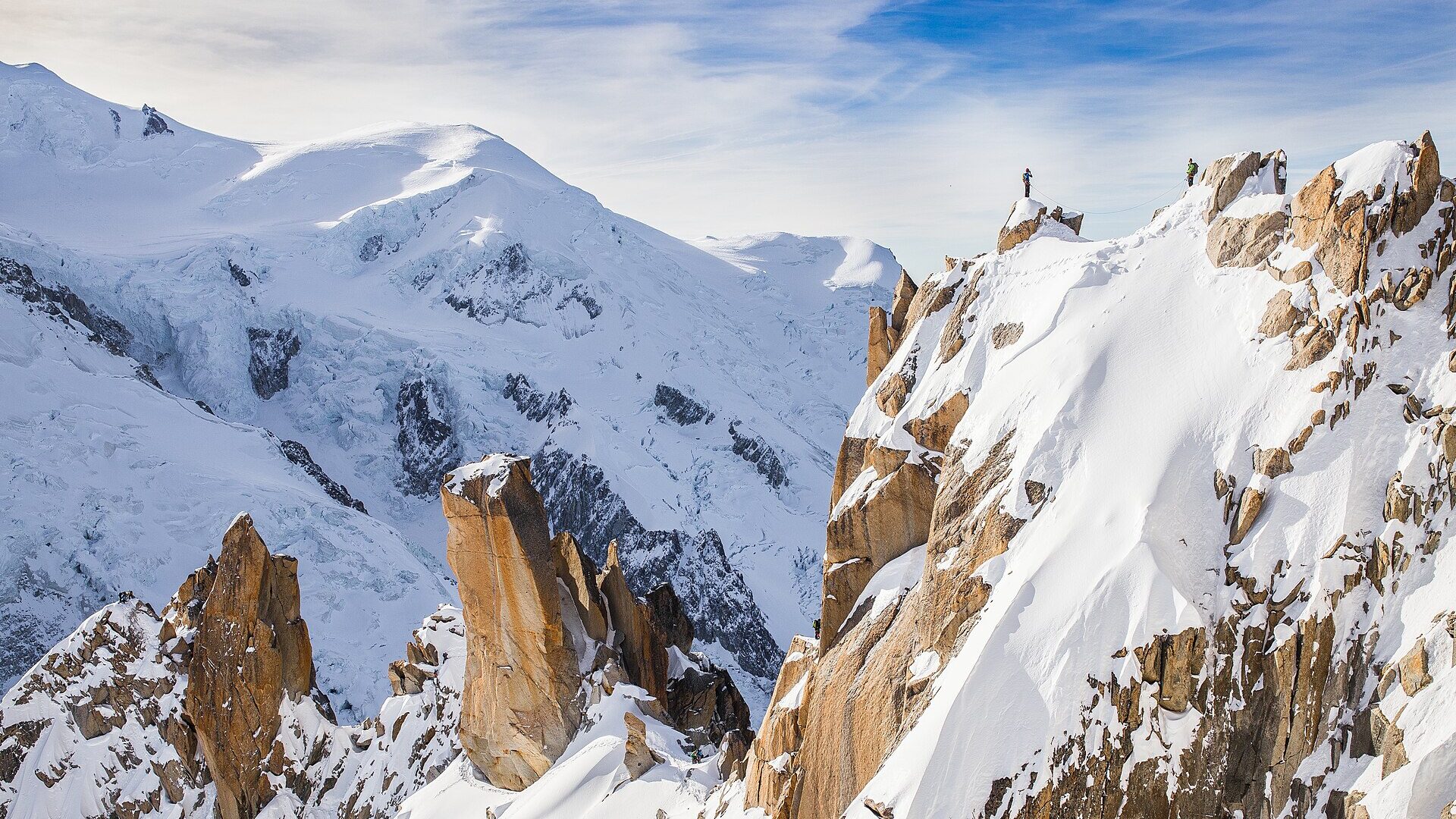

Vertical drop is the height difference between a ski resort’s lowest lift station and its highest, measured in metres. Chamonix has the biggest in our database at 2,807 m, from 1,035 m to 3,842 m; Ruka in Finland has 290 m. Across the 251 resorts on Intski the median is 1,100 m. Vertical is a better guide to how long your runs will be than slope kilometres or top elevation, but it can mislead: it says nothing about how much of that height you can ski in one go, or how wide the mountain is. This guide explains what the number means, where it comes from and how to read it.
Key takeaways
- Vertical drop = top station elevation minus base station elevation. It measures height, not distance skied.
- Median in our data is 1,100 m. 154 of 251 resorts have 1,000 m or more, 55 have 1,500 m or more, 21 have under 500 m.
- Biggest: Chamonix 2,807 m, Les Deux Alpes 2,300 m, Zermatt 2,263 m. Smallest: Winterberg 190 m, Ruka 290 m, Levi 331 m.
- By country, Switzerland’s median is 1,500 m, France 1,318 m, Austria 1,252 m, the United States 988 m, Norway 732 m, Finland 331 m.
- A big vertical does not mean big terrain: Chamonix’s 2,807 m sits on 152 km of pistes; Val Thorens has 930 m on the 3 Vallées’ 600 km.
How vertical drop is measured
Every resort page on Intski shows a base elevation, a top elevation and the difference between them. Base is the lowest point served by a lift, usually the village or the valley station; top is the highest lift station. Vertical is one minus the other. The figures come from the resorts’ own published statistics, and that is the first thing to know about them: resorts choose what to count.
Two things get counted differently. Some resorts publish the elevation of the village rather than the lowest lift, which adds vertical you cannot ski. And glacier resorts sometimes count a valley base and a glacier top that are connected by a single access lift with no piste back down. Kaprun in Austria shows 2,261 m of vertical, from the town at 768 m to the Kitzsteinhorn at 3,029 m, the fourth biggest in our data. You cannot ski it in one run; the lower slopes and the glacier are separate areas joined by lifts.
Linked ski areas add a second complication. Courchevel and Val Thorens both belong to the 3 Vallées and both show 600 km of slopes, but Courchevel’s vertical is 1,930 m from a 1,300 m base and Val Thorens’ is 930 m from a 2,300 m base. Same ski area, same top, different village. The slope kilometres describe the area; the vertical describes the village. Our guide to how big a “big” resort really is covers the same trap for kilometres.
The biggest vertical drops in our database
| # | Resort | Country | Base | Top | Vertical | Slopes |
|---|---|---|---|---|---|---|
| 1 | Chamonix | France | 1,035 m | 3,842 m | 2,807 m | 152 km |
| 2 | Les Deux Alpes | France | 1,300 m | 3,600 m | 2,300 m | 225 km |
| 3 | Zermatt | Switzerland | 1,620 m | 3,883 m | 2,263 m | 322 km |
| 4 | Kaprun | Austria | 768 m | 3,029 m | 2,261 m | 62 km |
| 5 | Alpe d’Huez | France | 1,120 m | 3,330 m | 2,210 m | 250 km |
| 6 | Vaujany | France | 1,250 m | 3,330 m | 2,080 m | 250 km |
| 7 | Cortina d’Ampezzo | Italy | 1,224 m | 3,269 m | 2,045 m | 120 km |
| 8 | Les Arcs | France | 1,200 m | 3,226 m | 2,026 m | 425 km |
| 9 | Grindelwald | Switzerland | 944 m | 2,970 m | 2,026 m | 206 km |
| 10 | Engelberg | Switzerland | 1,000 m | 3,020 m | 2,020 m | 82 km |
Source: Intski resort database, 251 resorts with published base and top elevations, checked 14 September 2026. Elevations are as published by the resorts; see the caveats above on Kaprun and on shared ski areas (Alpe d’Huez and Vaujany share the Grandes Rousses figures).
Eight of the ten are in France or Switzerland, and none is in North America. The biggest vertical in the United States in our data is 1,391 m; Jackson Hole has 1,261 m and Big Sky 1,330 m. That is not because American mountains are small. It is because their bases are high: Breckenridge starts at 2,926 m, the highest base in our database and above the midpoint of Chamonix’s vertical, and its highest lift reaches 3,914 m, higher than any lift in Europe. Its lift-served vertical is 988 m. Top elevation and vertical are different measurements, and our guide to why altitude matters for snow deals with the first.
Zermatt’s 2,263 m is measured from the Swiss village; from Cervinia on the Italian side the same 322 km area gives 1,833 m, a difference our Cervinia vs Zermatt comparison explains.
What vertical drop looks like by country
| Country | Resorts | Median vertical | Biggest |
|---|---|---|---|
| Switzerland | 30 | 1,500 m | Zermatt, 2,263 m |
| France | 40 | 1,318 m | Chamonix, 2,807 m |
| Italy | 30 | 1,282 m | Cortina d’Ampezzo, 2,045 m |
| Austria | 50 | 1,252 m | Kaprun, 2,261 m |
| Canada | 10 | 1,028 m | 1,713 m |
| United States | 19 | 988 m | 1,391 m |
| Japan | 7 | 967 m | 1,085 m |
| Germany | 8 | 940 m | 1,396 m |
| Norway | 4 | 732 m | Hemsedal, 830 m |
| Sweden | 3 | 470 m | 900 m |
| Finland | 3 | 331 m | Ylläs, 518 m |
The Alps sit between 1,250 m and 1,500 m at the median. The Rockies are lower on vertical and higher on altitude. The Nordic countries are a different sport: Norway offers real descents at Hemsedal and Norefjell, while Finland’s three resorts have 290 to 518 m and make up for it with dense lifts, long seasons and cold. Winterberg in Germany has the smallest vertical in our data at 190 m.
What the number tells you, and what it does not
Run length. A resort with 1,500 m of vertical has runs that can descend for ten minutes without a lift. With 300 m, the longest run is over in two or three. That is the honest use of the figure, and it is why strong skiers look at it first.
Weather range. A big vertical means the top and the bottom have different weather. When it rains in the valley at 1,000 m, it snows at 2,500 m, and when the top is in cloud, the tree line lower down still has visibility. Resorts with 2,000 m of vertical almost always have somewhere skiable.
Snow at the bottom. Vertical says nothing about where the snow is. Chamonix’s 1,035 m base is often bare in December while its top is deep; Val Thorens’ 2,300 m base has snow to the door with a third of the vertical. Read base elevation alongside vertical for early and late season trips.
Terrain size. Vertical and slope kilometres are independent. Chamonix has the biggest vertical in our data on a modest 152 km, spread across several separate areas; Les Arcs has 2,026 m on 425 km of linked Paradiski pistes. Kaprun has 2,261 m on 62 km. For a week’s variety, kilometres matter more; for a single memorable descent, vertical does.
Lift efficiency. Divide vertical by lift count and you get a rough sense of how big each lift is. Jackson Hole has 1,261 m on 13 lifts; Courchevel has 1,930 m on the 3 Vallées’ 166. One is a few big tramways, the other a network of short chairs linking villages.
How much vertical do you need
- Under 500 m: laps, not descents. Fine for beginners, families and anyone who values short lifts and no queues over long runs. Most of Finland and Sweden, Geilo in Norway, many German and Czech resorts.
- 500 to 1,000 m: enough for satisfying runs. Trysil and Hemsedal in Norway, many North American resorts by vertical alone, most Italian Dolomites villages.
- 1,000 to 1,500 m: the Alpine standard. Ischgl at 1,495 m and St. Anton at 1,507 m are typical big Austrian resorts, and our comparison of the two shows how little the vertical separates them when everything else differs. Mayrhofen vs Saalbach is the opposite case: 1,870 m against 1,093 m.
- Over 2,000 m: ten resorts in our data, all in the Alps. Long, high, weather-proof mountains where a single top-to-bottom run is the point of the trip.
Vertical is one of the numbers in the compare tool, where you can set it against slope kilometres, lift count and base elevation for any two resorts. The highest resorts rankings sort by top elevation instead, which answers a different question.
Comparing two resorts? Open the compare tool and set vertical, base elevation and slope kilometres side by side.
Quick answers
What does vertical drop mean in skiing?
The height difference in metres between a ski resort’s lowest and highest lift stations. Chamonix’s lifts run from 1,035 m to 3,842 m, so its vertical drop is 2,807 m. It measures height, not the length of the runs.
Which ski resort has the biggest vertical drop?
In our database of 251 resorts, Chamonix in France with 2,807 m, followed by Les Deux Alpes (2,300 m) and Zermatt (2,263 m). All ten resorts above 2,000 m are in the Alps.
What is a good vertical drop for a ski resort?
The median in our data is 1,100 m. Anything over 1,000 m gives long runs; over 1,500 m is a big mountain; under 500 m means short laps, which suits beginners and families.
Is vertical drop the same as elevation?
No. Elevation is the height above sea level of a point, usually the top or base station. Vertical drop is the difference between the two. Breckenridge has a higher top lift (3,914 m) than Chamonix (3,842 m) but a vertical of 988 m against Chamonix’s 2,807 m, because its base is at 2,926 m.
Does a bigger vertical drop mean better skiing?
Not by itself. It means longer runs and more weather range, but says nothing about terrain size, snow at the base or lift quality. Val Thorens has 930 m of vertical and 600 km of linked pistes; Kaprun has 2,261 m and 62 km.
Why do some resorts in the same ski area show different vertical drops?
Because vertical is measured from each village’s own base. Courchevel (1,300 m base) and Val Thorens (2,300 m base) share the 3 Vallées and its 3,230 m top, so their verticals are 1,930 m and 930 m.