


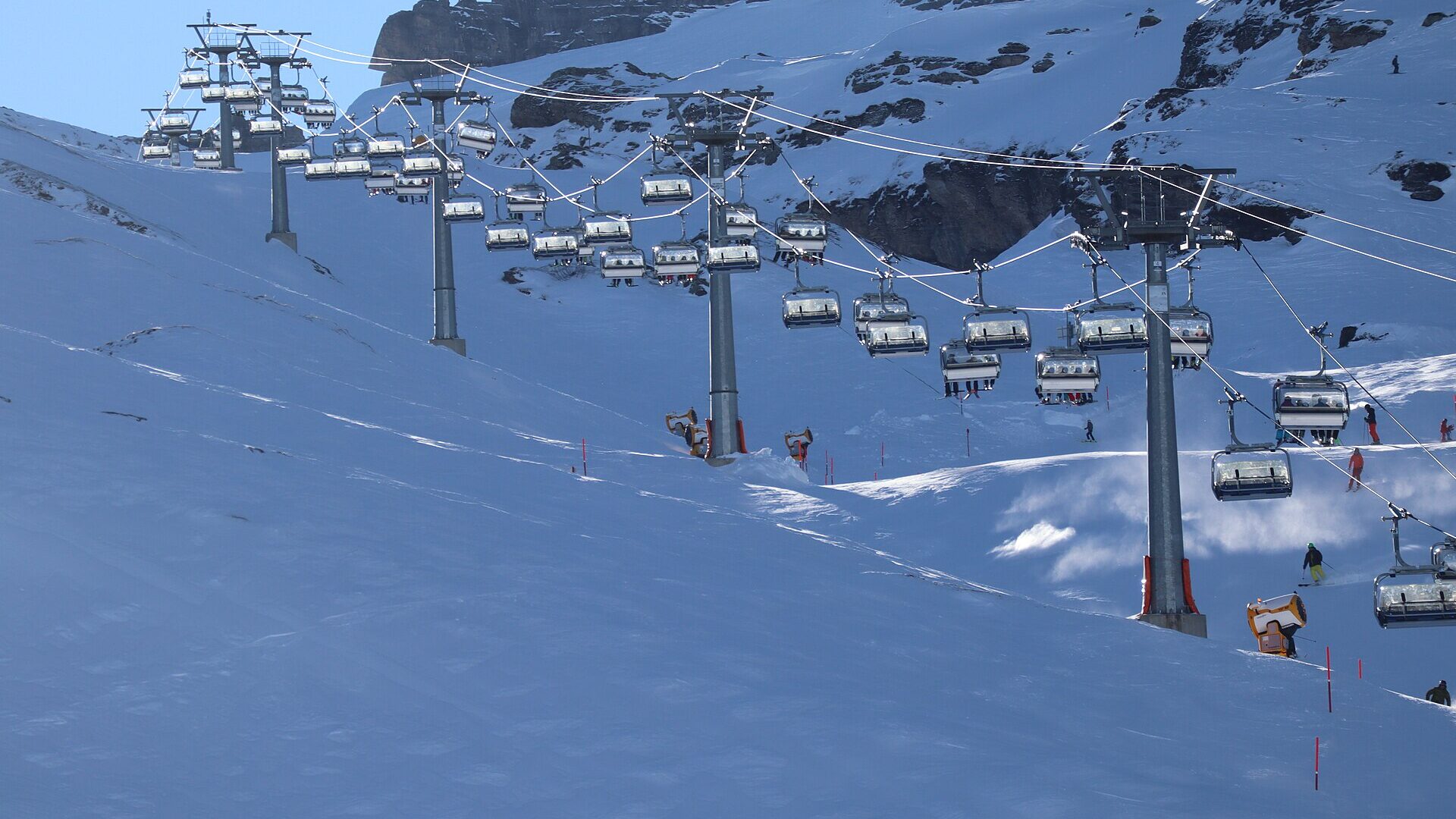

Ask why one resort has good cover in early December while another is skiing on strips of machine-made snow, and the answer is almost always altitude. Across the 198 European resorts in the intski database the median top station is about 2,550 m; 36 resorts reach 3,000 m or higher and 40 top out below 2,000 m. At the base the spread is wider still: the median is roughly 1,225 m, only 10 resorts have a base village at 2,000 m or above, and 65 start below 1,000 m. Those numbers decide whether you ski to the door in mid-December or ride a lift down at 3 pm in March.
The physics, kept simple
Air gets colder as you go up
Temperature falls with altitude by roughly 6.5 °C per 1,000 m on average (it varies day to day, and valley inversions can reverse it on calm mornings). When a valley at 1,000 m sits at +4 °C, the 2,000 m contour is near −2 °C and 3,000 m is around −9 °C. Rain in the valley is therefore snow higher up: the rain-snow line sits where the air is between 0 °C and about +1 °C, and each degree of warming lifts it by roughly 150 m. Snow that has already fallen lasts longer where it stays frozen. Snowmaking obeys the same threshold: snow guns need sub-zero temperatures, colder still in humid air, so a higher resort simply gets more snowmaking hours in November and December.
Aspect: north faces keep their snow
In winter the sun sits low in the southern sky, so north-facing slopes receive little direct sun and their snow stays cold and dry. South-facing slopes soften by late morning, refreeze overnight and by March are cycling between slush and ice. The runs that keep skiing well in a warm spell are the north-facing ones at altitude.
Glaciers: a base that does not melt
Glacier resorts sit on permanent ice, so fresh snow lands on a frozen surface rather than on rock or grass and the lifts can run as soon as there is enough cover to protect the ice. That is why the only two October openers in our data, Sölden (two glaciers, top station 3,250 m) and Tignes (Grande Motte glacier, 3,456 m), are glacier resorts. Alpine glaciers have shrunk for decades, but they remain Europe’s most reliable early- and late-season snow.
Why vertical is a separate question
Vertical drop, top station minus base, cuts both ways. A big vertical spans several climate zones, so the top may be −10 °C and dry while the run home is slush. It also gives you options: high, north-facing terrain in a thaw, and lower, sheltered runs when wind closes the top lifts.
Reading base, top and vertical
- Top station is the best single guide to snow reliability. Above about 2,500 m in the Alps you can expect winter conditions from December to April in most years; above 3,000 m the season stretches at both ends. In our data, 112 of 198 European resorts reach 2,500 m and 36 reach 3,000 m.
- Base altitude describes the village and the run home. Val Thorens at 2,300 m, the highest resort village in Europe, has snow at the door all season. Chamonix, with a valley floor at 1,035 m under lifts that reach 3,842 m, can be green at the bottom while the top skis well.
- Vertical tells you how much of the mountain sits in the warm zone. It is top station minus base, not one continuous run.
Europe’s highest ski resorts
Ranked by lift-served top station; where villages share a linked area, the highest point belongs to the area. The full list is at highest ski resorts in Europe.
| Resort | Country | Top (m) | Base (m) | Vertical (m) | Season |
|---|---|---|---|---|---|
| Zermatt | Switzerland | 3,883 | 1,620 | 2,263 | November to May |
| Cervinia | Italy | 3,883 | 2,050 | 1,833 | November to May |
| Chamonix | France | 3,842 | 1,035 | 2,807 | December to May |
| Les Deux Alpes | France | 3,600 | 1,300 | 2,300 | December to April |
| Saas Fee | Switzerland | 3,573 | 1,800 | 1,773 | December to April |
| Tignes | France | 3,456 | 1,550 | 1,906 | October to May |
| Val d’Isère | France | 3,456 | 1,550 | 1,906 | November to May |
| Alpe d’Huez | France | 3,330 | 1,120 | 2,210 | December to April |
| Verbier | Switzerland | 3,330 | 1,500 | 1,830 | November to April |
| Gudauri | Georgia | 3,307 | 2,196 | 1,111 | December to April |
| St. Moritz | Switzerland | 3,303 | 1,822 | 1,481 | November to April |
| Sierra Nevada | Spain | 3,300 | 2,100 | 1,200 | December to April |
| Cortina d’Ampezzo | Italy | 3,269 | 1,224 | 2,045 | December to April |
| Hintertux | Austria | 3,250 | 1,500 | 1,750 | December to April |
| La Plagne | France | 3,250 | 1,250 | 2,000 | December to April |
| Sölden | Austria | 3,250 | 1,350 | 1,900 | October to May |
Vaujany sits in the Alpe d’Huez Grand Domaine at 3,330 m, and Nendaz and Thyon-Les Collons share Verbier’s 4 Vallées top of 3,330 m; Arabba shares Cortina’s 3,269 m in the Dolomiti Superski network, and Tux the Hintertux glacier’s 3,250 m. Just below the table come Val Thorens and Les Menuires (3,230 m), Les Arcs (3,226 m), Stubaier Gletscher (3,210 m) and Palandöken in Turkey (3,176 m). Chamonix’s figure is the top of the lift serving the Vallée Blanche, an unpisted glacier descent, rather than a marked run.
The highest base villages
Sleeping high means ski-in, ski-out that works in December and no long, soft run home in March. Only ten European resorts in our data have a base at 2,000 m or above: Val Thorens (2,300 m), Palandöken (2,200 m), Gudauri (2,196 m), Obergurgl-Hochgurgl (2,150 m), Sierra Nevada (2,100 m), Cervinia (2,050 m), Pas de la Casa (2,050 m), Sestriere (2,035 m), Isola 2000 (2,000 m) and Germany’s Zugspitze glacier area (2,000 m). Traditional villages sit lower, which is why Zermatt (1,620 m) and St. Moritz (1,822 m) pair a high top station with a valley-floor village.
The biggest verticals
Chamonix’s 2,807 m is the largest lift-served vertical in our European data by a wide margin. Les Deux Alpes (2,300 m), Zermatt (2,263 m), Kaprun (2,261 m, from a 768 m valley to a 3,029 m glacier), Alpe d’Huez (2,210 m), Vaujany (2,080 m), Cortina d’Ampezzo (2,045 m), Grindelwald and Les Arcs (2,026 m each) and Engelberg (2,020 m) complete the list of European resorts with 2,000 m or more. Kaprun and Engelberg both start below 1,000 m and rely on their glaciers for early- and late-season snow.
Where altitude is not the answer
Altitude is the best single predictor of snow in the Alps, but not the only route to a reliable season. Latitude works too: Finland’s Levi (top 531 m), Ruka (492 m) and Ylläs (718 m) run December to April at heights that would not hold snow in the Alps, because winters that far north are long and cold. So does snowfall: Niseko tops out at 1,308 m yet stays open into May on more than 14 metres of snow a year.
High resorts have costs too: treeless terrain above 2,500 m means flat light in cloud, and the top lifts close first in wind. Beginners and families are often better served by a mid-altitude resort with tree-lined runs and good snowmaking. Seventy of the 198 European resorts in our data carry our snow-sure tag; use it alongside the altitude columns in the compare tool, and filter by both in the resort finder.
Quick answers
What is the highest ski resort in Europe?
By lift-served top station, Zermatt in Switzerland and Cervinia in Italy, which share a linked area reaching 3,883 m. Chamonix follows at 3,842 m. By base village, Val Thorens at 2,300 m is the highest resort in Europe.
How much colder is it at the top of a ski resort?
On average about 6.5 °C per 1,000 m, so a top station 2,000 m above the valley is typically around 13 °C colder. Inversions on calm mornings can temporarily reverse this.
Does a higher resort guarantee better snow?
No, but it raises the odds: height keeps precipitation falling as snow, preserves what has fallen and extends snowmaking hours. Aspect, latitude, snowfall and glacier cover matter too, which is why Niseko at 1,308 m and Levi at 531 m have long seasons.
Which matters more, base altitude or top altitude?
Top altitude for the pistes, base altitude for the village and the run home. A resort with a 3,000 m top and a 900 m base skis well up high in a thaw while the valley runs close.


