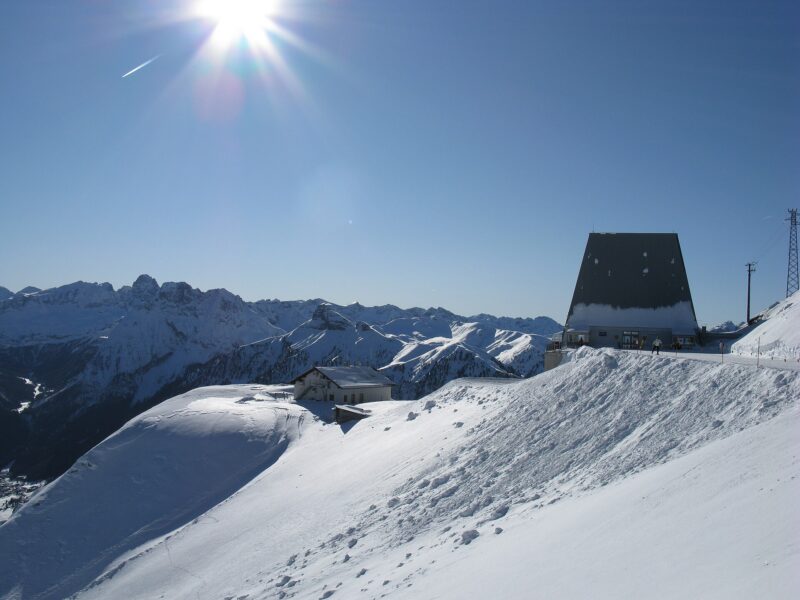
Cortina d’Ampezzo
Slope Breakdown
Cortina d’Ampezzo at a glance
Cortina d’Ampezzo is a ski resort in Italy, part of the Dolomiti Superski ski area. It offers 120 km of slopes served by 36 lifts, with skiing between 1,224 m and 3,269 m (2,045 m vertical). That makes it the 14th largest of the 30 ski resorts in Italy listed on Intski. The season usually runs from December to April. Cortina d’Ampezzo offers a balanced mix: 38% easy, 49% intermediate and 13% expert slopes. Freestylers get 1 snow park.
Top features of this resort
Snow forecast
About 22 cm of new snow at the top (3,269 m) in the next 3 days, none at the base.
New snow and temperature at the top station. Estimated by Intski from the MET Norway forecast, updated every few hours. Where it snows most this week
Email me when it snows
An alert when 15 cm or more is on the way at Cortina d’Ampezzo, and a heads-up before it opens.
Getting there & lift pass
Nearest airport
Bolzano (BZO) — about 62 km from the resort, straight-line distance, allow more by road.
Lift pass
Adult day pass around 80 EUR (2025/26 season). Cortina local day pass, high season rate.
About €0.67 per km of piste the pass covers (120 km).
Compare lift pass prices at all resortsPrice source, checked 2026-09-14
Driving to Cortina d’Ampezzo
Rules for a car in Italy, checked 30 September 2026 against official sources.
Road charge
Motorway tolls by distance
Winter tyres
Winter tyres or chains on board, 15 Nov to 15 Apr, on signed roads (Valle d'Aosta from 15 Oct)
Studded tyres
Unclear: allowed up to 3.5 t; the period is not confirmed on an official page
Cortina d’Ampezzo resort facts
Difficulty shares from skiresort.info, applied to the area total.
About Cortina d’Ampezzo
Cortina d'Ampezzo, usually shortened to Cortina, is a town and comune in the province of Belluno, in Italy's Veneto region.
Resort Highlights
Olympic town in the Ampezzo valley
Cortina d’Ampezzo, usually shortened to Cortina, is a town and comune in the province of Belluno, in Italy’s Veneto region. It lies on the Boite river in an alpine valley at the heart of the southern Dolomites and belongs to Ladinia, the Ladin linguistic and cultural region; in local Ladin the town is Anpezo. Its reputation is upscale: a summer and winter resort known for its ski trails, scenery, accommodation, shops and a jet-set après-ski scene. The town’s Latin motto, granted in 1928, translates roughly as ‘I live frugally and rest quietly’, which sits amusingly beside that reputation.
The skiing
Cortina’s own ski area covers 120 km of pistes with 36 lifts and one terrain park, and it is part of the Dolomiti Superski pass. The published split is 46 km easy, 59 km intermediate and 15 km expert: about half the terrain is intermediate, a generous 38 per cent is easy and 13 per cent is expert, a mix that favours cruising and progression over sustained steeps. The lift system is listed as modern.
The altitude figures are striking. The base sits at 1,224 m and the top lift at 3,269 m, a vertical of 2,045 m. The town is relatively low, but the upper slopes reach far above 2,200 m and hold their snow well through the December-to-April season. That high terrain, combined with the Superski pass, is what lifts Cortina beyond its 120 km on paper.
History
Few ski towns have a past this layered. In the Middle Ages Cortina fell under the Patriarchate of Aquileia and the Holy Roman Empire; Venice conquered it in 1420, and from 1508 it spent most of four centuries under Habsburg rule, apart from a Napoleonic interlude, until 1918. From the 19th century it became a regional centre for crafts, wood furniture, tiled stoves and iron, copper and glass work that early British and German holidaymakers prized as tourism emerged. The 1944 Winter Olympics scheduled for Cortina were cancelled by the Second World War; it hosted the Games in 1956 and again in 2026, co-hosting with Milan. It is also home to SG Cortina, a top-league ice hockey team, and to the start and finish of the annual Dolomites Gold Cup Race.
The town today
The economy runs on tourism: in winter the population swells from about 7,000 to around 40,000. The Basilica Minore dei Santi Filippo e Giacomo, built between 1769 and 1775, anchors the centre, and there are museums of palaeontology, modern art and ethnography. Several films have been shot here. Traditional charm and scenic views are listed strengths, and both are easy to credit.
Practical
Bolzano airport is roughly 62 km away as the crow flies. The resort’s official website covers local information.
Frequently asked questions about Cortina d’Ampezzo
Yes, twice: in 1956 and in 2026, when it co-hosted with Milan. The 1944 Games scheduled for Cortina were cancelled because of the Second World War.
Cortina is part of Dolomiti Superski. Its own ski area has 120 km of pistes, 36 lifts and one terrain park.
The town has about 7,000 residents, but in the winter season the population typically rises to around 40,000.
Cortina is part of Ladinia, the Ladin linguistic and cultural region. In local Ladin it is called Anpezo.
The Rinaldo Zardini Palaeontology Museum, the Mario Rimoldi Modern Art Museum and the Regole of Ampezzo Ethnographic Museum.
Cortina d’Ampezzo has 120 km of marked slopes: 46 km easy (blue), 59 km intermediate (red), 15 km expert (black), served by 36 ski lifts.
The skiing in Cortina d’Ampezzo ranges from 1,224 m at the base to 3,269 m at the top — a vertical drop of 2,045 m.
The ski season in Cortina d’Ampezzo typically runs from December to April. Exact opening dates vary by year and snow conditions.
Cortina d’Ampezzo works for beginners, though it is not a dedicated beginner resort: about 38% of the slopes (46 km) are easy blue runs.
Cortina d’Ampezzo has 15 km of expert (black) slopes — about 13% of the total. There is 1 snow park for freestylers.
Skier reviews
Been to Cortina d’Ampezzo? Tell other skiers what it is really like.
Sign in to leave a review
We ask for an account so every review comes from a real person. It takes about ten seconds and keeps this page free of spam.