
Every resort website leads with a kilometre figure, and the biggest numbers are not always what they seem. Here is what the figures look like across the 251 resorts in 26 countries in the intski database, what a kilometre of piste means for a day on skis, and how to read lift counts and vertical drop alongside it.
The distribution: what is normal
The median resort in our data has 119 km of marked pistes; a quarter have 50 km or less and a quarter have 210 km or more. The mean is 164 km, pulled upwards by a few very large linked areas.
| Piste kilometres | Resorts | Share of database |
|---|---|---|
| Under 50 km | 58 | 23% |
| 50 to 99 km | 41 | 16% |
| 100 to 199 km | 83 | 33% |
| 200 to 299 km | 36 | 14% |
| 300 to 399 km | 9 | 4% |
| 400 km and more | 24 | 10% |
Put another way, 152 resorts (61%) offer at least 100 km, 69 (27%) at least 200 km, 33 (13%) at least 300 km and 24 (10%) at least 400 km. Country matters: the median French resort has 258 km, Swiss 180 km, Italian 125 km and Austrian 120 km, while Japan (50 km), Norway (47 km), New Zealand (38 km) and Germany (35 km) show that a good ski trip does not need three figures.
What one kilometre of piste means for your day
There is no international standard for measuring piste length: some resorts measure the centre line of each marked run, some count every variant and link, and a few have been found to round generously. Treat the figure as an index rather than a measurement.
In practice, a 1 km run of average gradient takes a competent intermediate two to four minutes without stopping. Add lift rides, queues, lunch and rests, and most recreational skiers cover 20 to 40 km of piste a day; a long, hard day is 50 km or more. So:
- 50 km of pistes gives two or three days of skiing without repeating runs: plenty for a weekend, a beginner week or a family trip built around lessons.
- 100 km fills a week for most people; beyond 200 km few skiers see the whole area in a week.
Past that point the kilometre count stops describing your holiday; what matters more is how the runs are distributed, whether the difficulty mix suits you, and how much of the area you can reach and return from in a day.
The linked-area caveat
The largest figures in our data are not single resorts. They are pass networks or lift-linked areas that several villages report as their own. Canazei and Campitello di Fassa list 1,200 km and 450 lifts, the whole Dolomiti Superski pass network, while other villages on the same pass list their local areas: Val Gardena 175 km, Alta Badia 130 km, Cortina d’Ampezzo 120 km. Flachau lists 760 km, the Ski Amadé pass region, while Schladming (123 km) and Bad Gastein (200 km) in the same region list their own sectors.
The French mega-areas are reported more consistently because they are lift-linked. Courchevel, Méribel, Val Thorens, Les Menuires and Saint Martin de Belleville all list the 3 Vallées total of 600 km and 166 lifts. Morzine, Avoriaz, Les Gets, Châtel and Champéry list the Portes du Soleil at 600 to 650 km. Paradiski (425 km) appears on both La Plagne and Les Arcs, the 4 Vallées (410 km) on Verbier, Nendaz and Thyon-Les Collons, and the Via Lattea (400 km) on Sestriere, Sauze d’Oulx and Montgenèvre.
So when we rank by size we say “ski area” for these entries. Before booking on a big number, ask whether the area is lift-linked on skis or a pass covering separate mountains reached by bus, and how much of it you can reach from your village and return from before the lifts close. The ranking of the biggest ski resorts in Europe shows the ski-area name next to each entry.
Lifts: count versus capacity
The median resort in our data has 28 lifts and about 3.6 km of piste per lift. Sälen in Sweden lists 100 km on 100 lifts and Hakuba 137 km on 111: many short lifts serving many short runs. At the other end, Kicking Horse lists 128 km on 5 lifts, Lake Louise 145 km on 10, Fernie 142 km on 10 and Jackson Hole 133 km on 13. North American resorts measure terrain in acres and run a few high-capacity lifts into large open bowls, so their kilometre figures are conversions.
Lift count is a poor proxy for capacity: one modern ten-seat gondola moves more people an hour than five old drag lifts, which is why our resort pages carry a separate “modern lifts” tag. Many lifts with few kilometres usually means a fragmented area of short runs, good for beginners and mixed groups; few lifts with many kilometres means long runs, long rides and more exposure to a single closure.
Vertical drop
Vertical drop, top station minus base, is the third number worth reading. The median across our 251 resorts is 1,100 m; 55 resorts have 1,500 m or more, 11 have 2,000 m or more, and 21 have under 500 m.
| Resort | Country | Base (m) | Top (m) | Vertical (m) |
|---|---|---|---|---|
| Chamonix | France | 1,035 | 3,842 | 2,807 |
| Les Deux Alpes | France | 1,300 | 3,600 | 2,300 |
| Zermatt | Switzerland | 1,620 | 3,883 | 2,263 |
| Kaprun | Austria | 768 | 3,029 | 2,261 |
| Alpe d’Huez | France | 1,120 | 3,330 | 2,210 |
| Vaujany | France | 1,250 | 3,330 | 2,080 |
| Cortina d’Ampezzo | Italy | 1,224 | 3,269 | 2,045 |
| Grindelwald | Switzerland | 944 | 2,970 | 2,026 |
| Les Arcs | France | 1,200 | 3,226 | 2,026 |
| Engelberg | Switzerland | 1,000 | 3,020 | 2,020 |
| La Plagne | France | 1,250 | 3,250 | 2,000 |
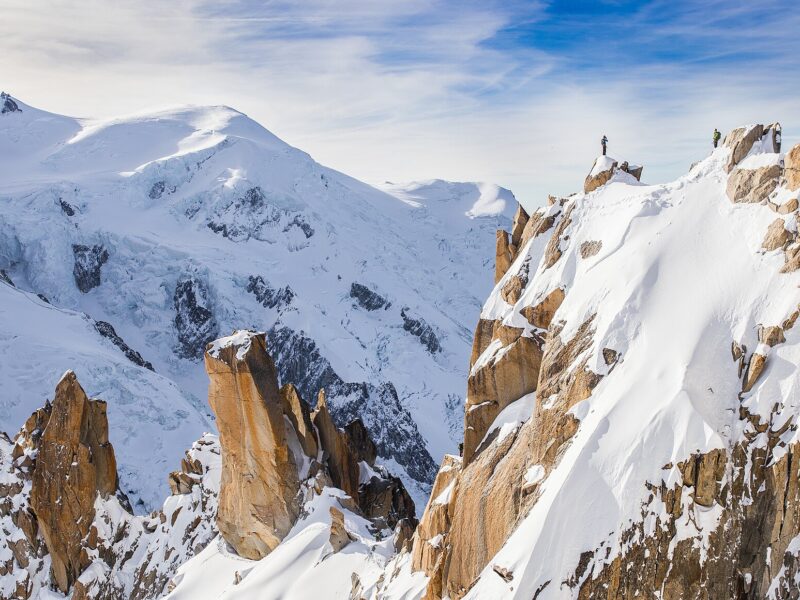
Two cautions. Lift-served vertical is rarely one continuous run: Chamonix’s 3,842 m is the top of the lift serving the Vallée Blanche, an unpisted glacier descent. And a large vertical with a low base puts the bottom third of the mountain in the warm zone: Kaprun (base 768 m) and Grindelwald (944 m) ski well up high in a thaw while their valley runs close. Read vertical as variety: a 2,000 m mountain offers glacier, bowl and tree-lined runs in one day.
So, how big is big?
One more number first. For the 35 resorts in our data with a difficulty breakdown, the pistes split 26% easy, 47% intermediate and 27% expert. Beginners should look at the easy-piste figure and the nursery area rather than the total, which is why our ranking of the best resorts for beginners weights those instead of size. A practical scale, using the counts from our data:
- Under 50 km: small. 58 resorts. Day trips, beginners and families skiing around lessons.
- 50 to 100 km: medium. 41 resorts. A week for beginners and relaxed intermediates.
- 100 to 200 km: large. 83 resorts, a third of the database. A full week for most skiers.
- 200 to 400 km: very large. 45 resorts. A different sector every day.
- 400 km and more: linked mega-areas. 24 entries, all villages inside eight linked or pass-based areas; check what is lift-linked before you book.
Compare specific resorts on pistes, lifts and vertical in the compare tool, or filter by size within a country (biggest in Austria, France, Switzerland, Italy) or with the resort finder.
Quick answers
How many kilometres of piste does an average ski resort have?
The median across the 251 resorts in the intski database is 119 km; half fall between 50 km and 210 km, and 23% have under 50 km.
Is 100 km of piste a lot?
Enough for a week for most skiers, who cover 20 to 40 km a day. In our data 61% of resorts have at least 100 km and 27% at least 200 km.
Which ski area has the most kilometres of piste?
All the largest figures in our data are linked areas: Dolomiti Superski at 1,200 km, Ski Amadé at 760 km, the Portes du Soleil at 600 to 650 km and the 3 Vallées at 600 km. None is a single resort.
What is a good vertical drop for a ski resort?
The median in our data is 1,100 m. Above 1,500 m (55 resorts) gives real variety of terrain and climate; only 11 resorts reach 2,000 m, led by Chamonix at 2,807 m.