


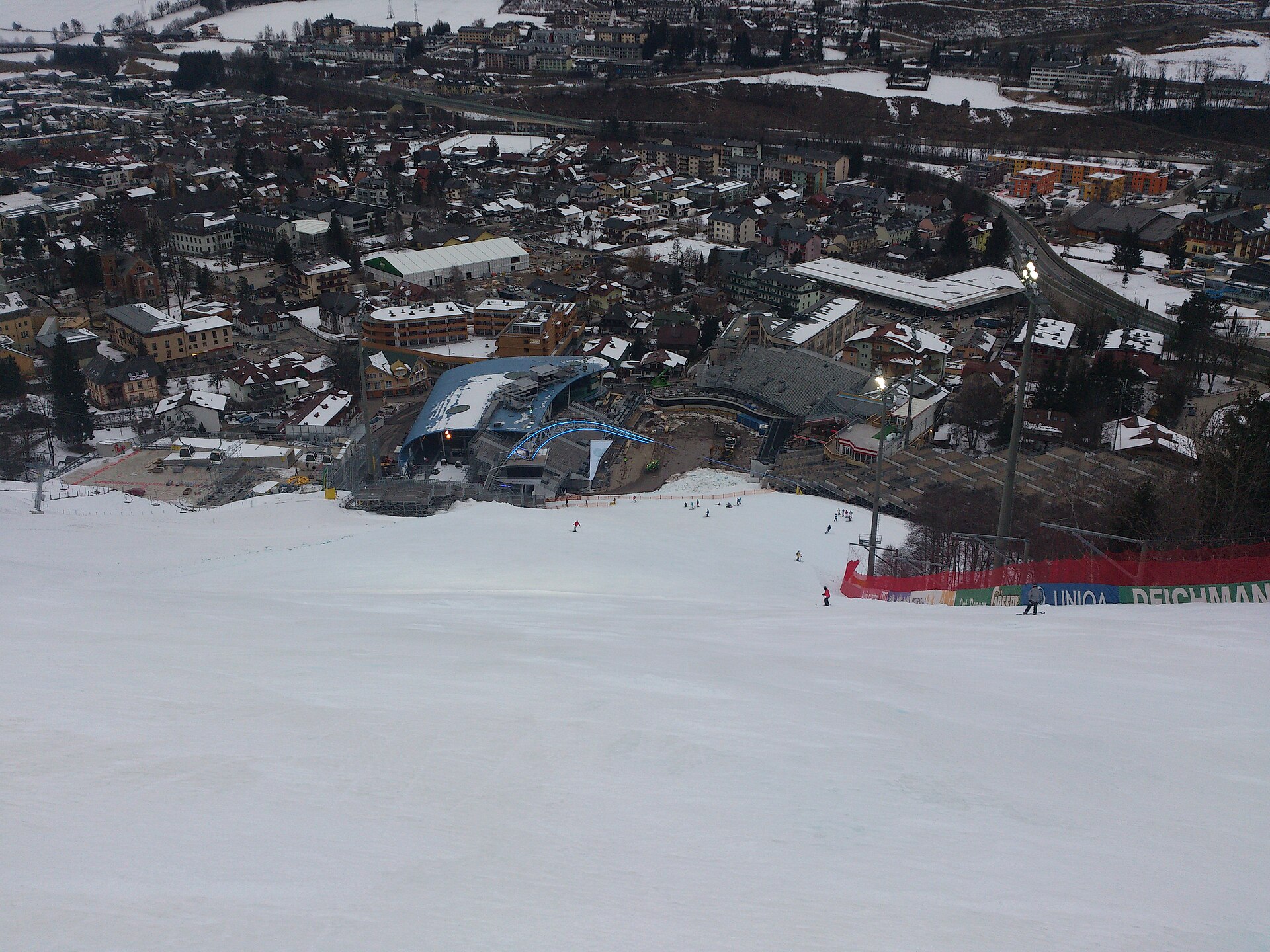
Slope Breakdown
Schladming at a glance
Schladming is a ski resort in Austria, part of the Ski Amadé ski area. It offers 123 km of slopes served by 44 lifts, with skiing between 745 m and 2,015 m (1,270 m vertical). That makes it the 25th largest of the 49 ski resorts in Austria listed on Intski. The season usually runs from December to April. Schladming is an intermediate's mountain: roughly 55% of the slopes are red runs.
Top features of this resort
Snow forecast
About 15 cm of new snow at the top (2,015 m) in the next 3 days, none at the base.
New snow and temperature at the top station. Estimated by Intski from the MET Norway forecast, updated every few hours. Where it snows most this week
Email me when it snows
An alert when 15 cm or more is on the way at Schladming, and a heads-up before it opens.
Getting there & lift pass
Nearest airport
Salzburg (SZG) — about 68 km from the resort, straight-line distance, allow more by road.
Lift pass
Adult day pass around 81.50 EUR (2026/27 season). Schladming-Dachstein 4-Berge-Skischaukel day pass. Valid across a wider pass network, not only this resort.
Compare lift pass prices at all resortsPrice source, checked 2026-09-14
Driving to Schladming
Rules for a car in Austria, checked 30 September 2026 against official sources.
Road charge
Vignette, plus tunnel and Brenner tolls. 1-day vignette (digital only) €9.60, 10-day vignette (digital or sticker) €12.80, 2-month vignette (digital or sticker) €32.00
Winter tyres
Required in wintry conditions, 1 Nov to 15 Apr
Studded tyres
Allowed 1 Oct to 31 May (up to 3.5 t, rear sticker, 80/100 km/h)
Schladming resort facts
Difficulty shares from skiresort.info, applied to the area total.
About Schladming
Schladming is a small town in the north-west of the Austrian state of Styria with a past in mining and a present built almost entirely on tourism.
Resort Highlights
A former mining town turned championship venue
Schladming is a small town in the north-west of the Austrian state of Styria with a past in mining and a present built almost entirely on tourism. It has grown into a large winter-sports resort and has twice staged the FIS Alpine World Ski Championships, in 1982 and again in 2013, a pedigree that shapes how the town sees itself. This is a working town with a proper centre. The shopping area is lined with cafes, restaurants and shops aimed at visitors, which gives it an evening life that purpose-built resorts struggle to match.
The skiing
The local ski area offers 123 km of pistes served by 44 lifts, between a base of about 745 m and a top of 2,015 m. That is a vertical of around 1,270 m, generous for an area whose summit only just clears 2,000 m, and long top-to-bottom descents are one of its defining features. Skiers who like to string together a full run from summit to valley without stopping will find plenty to enjoy, and the World Championship history is evidence that the steeper pistes are of a serious standard.
The top height is modest, so snow on the lower runs is more dependent on the weather than in high-altitude resorts, and the December to April season is best enjoyed in its middle months. The lift system is modern, and the ratio of 44 lifts to 123 km means uplift is rarely a bottleneck. Schladming’s lift pass is part of Ski Amade, a multi-area ticket that opens up a far larger choice of ski areas than the local 123 km figure suggests, for those prepared to travel between them. For a week’s holiday, that combination of a serious home mountain and a wider pass makes the town a sensible base for skiers who like the option of a day trip without committing to one.
Town and apres-ski
Schladming’s apres-ski is lively, and the town centre means evenings do not have to revolve entirely around the slopes. The cafes, restaurants and shops give it the feel of a place where people live and work as well as ski, which is exactly what it is: a mining town that reinvented itself around winter sport. For visitors who find purpose-built resorts sterile, that authenticity is a strong argument for choosing it.
Practical notes
Salzburg airport is roughly 68 km away as the crow flies. The season runs from December to April. The resort’s official website carries current lift, pass and event information.
Frequently asked questions about Schladming
Yes, twice. Schladming staged the FIS Alpine World Ski Championships in 1982 and again in 2013, and it continues to host skiing competitions.
Schladming belongs to Ski Amade, a multi-area lift pass. The local area has 123 km of pistes and 44 lifts, but the pass gives access to a much wider choice of ski areas for those willing to travel between them.
It is a former mining town in north-west Styria that has become a large winter-sports resort. It has a proper town centre with cafes, restaurants and shops catering to visitors.
Skiing runs from about 745 m up to 2,015 m, a vertical of roughly 1,270 m. Long top-to-bottom descents are a feature, though the modest summit height means lower slopes depend on the weather.
Schladming has 123 km of marked slopes: 46 km easy (blue), 68 km intermediate (red), 9 km expert (black), served by 44 ski lifts.
The skiing in Schladming ranges from 745 m at the base to 2,015 m at the top — a vertical drop of 1,270 m.
The ski season in Schladming typically runs from December to April. Exact opening dates vary by year and snow conditions.
Schladming works for beginners, though it is not a dedicated beginner resort: about 37% of the slopes (46 km) are easy blue runs.
Schladming has 9 km of expert (black) slopes — about 8% of the total.
An adult day pass in Schladming costs around 81.50 EUR (2026/27 season). Schladming-Dachstein 4-Berge-Skischaukel day pass. Valid across a wider pass network, not only this resort.
Skier reviews
Been to Schladming? Tell other skiers what it is really like.
Sign in to leave a review
We ask for an account so every review comes from a real person. It takes about ten seconds and keeps this page free of spam.
Nearby Resorts
Other ski resorts you might enjoy


