Family ski holidays are booked earlier than any other kind, because school holidays fix the dates and the family-sized apartments, childcare places and beginner ski school slots go first. If you are reading this in September with a February or Easter week in mind, this is the moment to decide where. The good news is that the things that make a resort work for children are measurable, and our resort database lets you check most of them before you look at a single hotel.
What matters for children
Easy terrain, and where it is
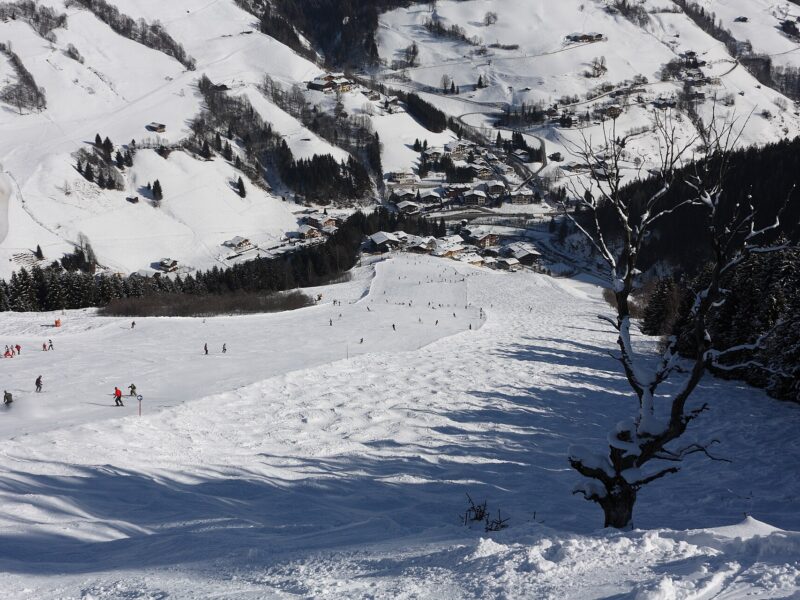
The share of a resort’s slopes classified as easy is the first number to look at. It tells you whether a child who has just left ski school will have somewhere to go besides the nursery slope. Among the 227 resorts in our database with a full slope breakdown, the median easy share is 38%, and the spread is wide: Villars in Switzerland grades 76% of its pistes blue, while plenty of well-known names sit below 30%. But the location of the easy runs matters as much as the total. A resort whose blue runs are up at 2,500 m, reached by a gondola with a queue, is harder work with a six-year-old than one with a gentle valley run back to the village.
Ski school and childcare
Look for a ski school with a dedicated kids’ area (a fenced “garden” with a magic carpet), lessons that start at age four or five, and lunch supervision so the day is not broken up by handovers. Non-skiing childcare for under-fours is rarer and books out first. If you have a toddler, this single factor may decide the resort.
Traditional village or purpose-built station?
Traditional villages give you a real town, a walk to the bakery, and something to do in bad weather. Purpose-built stations give you ski-in, ski-out convenience and no carrying of skis through a car park. With small children, convenience usually wins in the morning and the village wins in the afternoon. The shortlist below leans towards resorts our data flags for traditional character, with one Andorran entry because the numbers are good and the set-up is simple.
Snow parks
From about age nine or ten, a snow park with a small-features line is what keeps children interested. Our data records the number of parks per resort; 42 of the 258 resorts have at least one, and the shortlist notes them.
Altitude and small children
High resorts are more snow-sure, but very young children can sleep and eat badly at altitude. Medical advice for babies and toddlers is generally cautious about sleeping much above 2,000 m; check with your own doctor. In practice this rules in most Alpine villages and rules out a handful of high stations. Every resort page shows base and top elevation.
Logistics
Short transfers, a walkable meeting point for ski school, and a hire shop near the accommodation matter more than any headline number.
The data-backed shortlist
These nine resorts pair a usable stock of easy terrain with a village base below 2,000 m, and each has either traditional-character status, at least one snow park, or both. The easy share varies more than you might expect, from 28% at Livigno to 56% across the 3 Vallées above Méribel, against a median of 38% for the 227 resorts in our data with a difficulty breakdown. Figures are from our database; where a resort quotes its linked ski area rather than its own slopes, that is stated.
| Resort | Country | Slopes | Easy | Lifts | Parks | Elevation |
|---|---|---|---|---|---|---|
| Mayrhofen | Austria | 142 km | 44 km (31%) | 58 | 1 | 630–2,500 m |
| Kitzbühel | Austria | 234 km | 127 km (54%) | 56 | 1 | 800–2,000 m |
| Livigno | Italy | 115 km | 32 km (28%) | 31 | 2 | 1,816–2,798 m |
| Val Gardena | Italy | 175 km | 50 km (29%) | 79 | 2 | 1,236–2,518 m |
| Cortina d’Ampezzo | Italy | 120 km | 46 km (38%) | 36 | 1 | 1,224–3,269 m |
| Grandvalira | Andorra | 210 km | 98 km (47%) | 67 | 3 | 1,710–2,640 m |
| Morzine | France | 600 km (Portes du Soleil ski area) | 321 km (54%) | 196 | 4 | 1,000–2,466 m |
| Méribel | France | 600 km (3 Vallées ski area) | 336 km (56%) | 166 | 3 | 1,450–3,230 m |
| Niseko | Japan | 52 km | 16 km (31%) | 30 | 2 | 240–1,308 m |
Austria: Mayrhofen and Kitzbühel
Both are real towns with a low base (630 m and 800 m), which suits families with babies and gives you shops, pools and restaurants at your door. Mayrhofen has 58 lifts serving 142 km, of which 44 km, 31%, is blue; its snow-sure and modern-lift flags in our data are a bonus for a March week. Kitzbühel is the gentler of the two on paper, with 127 km of easy piste out of 234 km, 54%, on 56 lifts, but its top station is only 2,000 m, so it is better in January and February than at Easter.
Italy: Livigno, Val Gardena and Cortina
Livigno is the high option at 1,816 m base, snow-sure in our data, with two parks, though its 32 km of blue piste is 28% of the area, the lowest easy share on this list. Val Gardena has 79 lifts for 175 km, more than any other resort on the list that reports its own figures, which means short waits, and its traditional villages sit at a family-friendly 1,236 m. Cortina’s 120 km include 46 km of easy slopes, 38%, and the scenery is a reason on its own.
Andorra: Grandvalira
Grandvalira is the largest ski area in Andorra in our data, 210 km on 67 lifts with 3 parks, and 98 km of it, 47%, is graded easy. Its base sits at 1,710 m, which helps snow reliability, and lift passes are cheaper than in most of the Alps. Its neighbour Arinsal, in the Pal Arinsal area, is the compact alternative at 63 km with a 49% easy share. See our best family resorts in Andorra page for the detail.
France: Morzine and Méribel
Morzine is a traditional town at 1,000 m linked into the Portes du Soleil, 600 km of ski area with 196 lifts and four parks, and 321 km of that, 54%, is blue. Méribel sits in the middle of the 3 Vallées (600 km, 166 lifts, three parks) at 1,450 m with a traditional-character village. In both cases the km figure is the whole linked area, so treat it as an upper bound; the point for a family is that the local sectors near the village have plenty of easy terrain and the older children can roam. The France family page compares them alongside the purpose-built stations.
Japan: Niseko
Small on paper (52 km, 30 lifts) but with a 31% easy share, two parks, a base at 240 m and a season that runs to May in our data. It is flagged snow-sure and traditional in character, with après-ski for the parents.
How to narrow it down
- Start with the best family ski resorts in Europe ranking and the per-country pages, such as Austria, Italy and Switzerland. The full set is on the rankings hub.
- Put your final two or three resorts side by side in the compare tool to see easy km, lifts, parks and elevation together.
- Use the resort finder if you are open on country and want to filter by level and features from the start.
Booking timeline
- September: choose the resort, book accommodation for school-holiday weeks, and book childcare for under-fours.
- October: book ski school (group lessons for the children, and for you if needed) and any English-speaking private instructor for a first day.
- November: reserve rental equipment online, check whether children ski free at your resort and at what age, and buy winter sports insurance for the whole family.
- Two weeks before: check the resort’s snow report and lift-opening page, and confirm transfer times.
Quick answers
What age can children start ski school?
Most Alpine ski schools take children from four, some from three in a play-based kindergarten. Under-threes are looked after in non-skiing childcare, which is rarer and books out first.
Is a high resort a problem for a baby?
It can be. Medical advice is cautious about babies and toddlers sleeping much above 2,000 m. Most traditional villages sit well below that; check the base elevation on the resort page and ask your doctor.
Which resorts have the most easy terrain for children?
Among resorts with at least 20 km of piste, the highest easy shares in our data are Villars in Switzerland (76%), Valmorel in France (70%), Hemsedal in Norway (66%), Isola 2000 in France (62%) and Obertauern in Austria (61%). On the shortlist above, Méribel’s 3 Vallées leads at 56%, with Kitzbühel and Morzine at 54%.
Traditional village or purpose-built resort for a family?
Purpose-built stations win on ski-in, ski-out convenience with small children; traditional villages win on things to do off the slopes. With children under six, convenience usually matters more.