


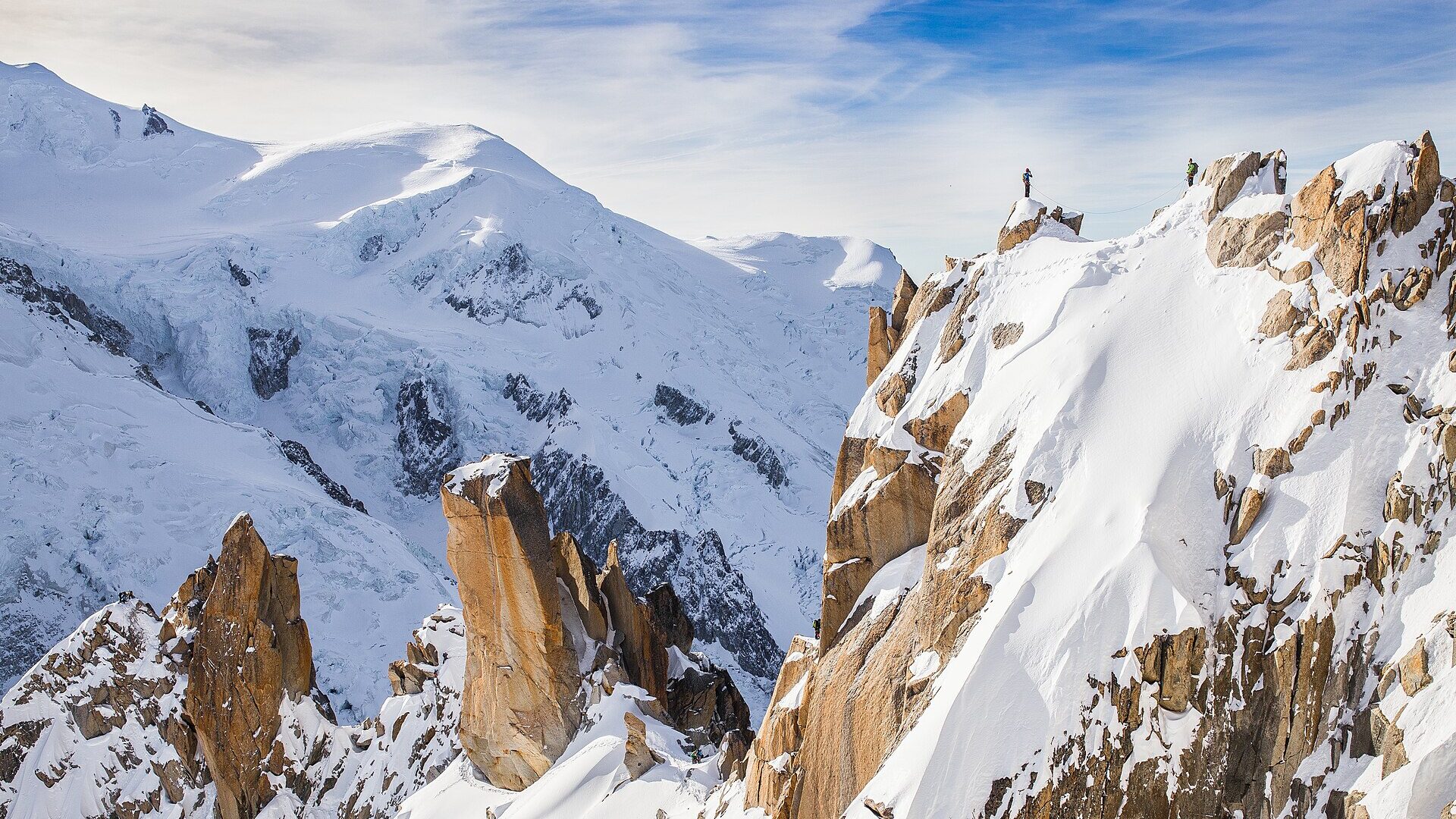
Leukerbad has the highest share of marked black runs of any sizeable European ski area in our data: 22 km of its 60 km, or 36.7%. Chamonix Mont-Blanc is next at 32.9% (50 km of 152 km), then Espace Killy, the linked area shared by Val d’Isère and Tignes, at 29.3% (88 km of 300 km). These are shares of marked black piste, not steepness or off-piste terrain. St. Anton’s reputation for hard skiing, for example, comes mostly from unpisted terrain and ski routes: its marked black share is 16.7%, roughly the European median. Zermatt’s is lower still, at 8.4%.
Key takeaways
- Leukerbad tops the ranking among resorts of at least 40 km: 36.7% marked black (22 of 60 km).
- Chamonix Mont-Blanc (32.9%) and Espace Killy, shared by Val d’Isère and Tignes (29.3%), take second and third.
- In absolute terms the 4 Vallées, shared by Verbier, Nendaz and Thyon-Les Collons, has the most black piste in Europe: 103 km, though that is only 25.1% of its 410 km.
- The median marked-black share across 104 European areas of 40 km or more in our data is 14.2%. St. Anton (Ski Arlberg) sits just above it at 16.7%; Zermatt-Cervinia sits well below it at 8.4%.
- Small resorts can post far higher shares: Bakuriani in Georgia is 48.3% black on just 29 km, and Uludağ in Turkey is 36.0% on 25 km.
- Switzerland has the highest median black-run share of any country with a meaningful sample: 16.7% across 17 areas, against 12.8% in France and 14.6% in Austria.
Which European ski resort has the highest share of black runs?
| # | Resort / ski area | Country | Slopes | Expert km | Expert share | Lifts |
|---|---|---|---|---|---|---|
| 1 | Leukerbad | Switzerland | 60 km | 22 km | 36.7% | 9 |
| 2 | Chamonix Mont-Blanc | France | 152 km | 50 km | 32.9% | 49 |
| 3 | Val d’Isère & Tignes (Espace Killy) | France | 300 km | 88 km | 29.3% | 79 |
| 4 | Galtür (Paznaun) | Austria | 43 km | 12 km | 27.9% | 10 |
| 5 | Trysil | Norway | 71 km | 19 km | 26.8% | 32 |
| 6 | Zinal (Val d’Anniviers) | Switzerland | 115 km | 30 km | 26.1% | 19 |
| 7 | Verbier, Nendaz & Thyon-Les Collons (4 Vallées) | Switzerland | 410 km | 103 km | 25.1% | 82 |
| 8 | Garmisch-Partenkirchen | Germany | 40 km | 10 km | 25.0% | 16 |
| 9 | Balderschwang | Germany | 40 km | 10 km | 25.0% | 10 |
| 10 | Zell am See (Zell am See-Kaprun) | Austria | 77 km | 19 km | 24.7% | 26 |
Source: Intski resort database, checked 28 September 2026. Ranking limited to areas of at least 40 km of total slopes, so that a single short black piste cannot top a list about hard mountains. Rows sharing one ski area carry identical total-slopes and lift figures because they are the same connected terrain, reached on the same lift network.
What a black-run share does and does not measure
Our figure is the share of a resort’s marked pistes graded black (expert): expert kilometres divided by total kilometres. It says nothing about steepness, avalanche exposure, off-piste terrain or the unmarked ski routes that give some mountains their reputation. That matters because the two most famous “hard” resorts in the Alps do not lead this ranking. St. Anton, in the Ski Arlberg area with Lech Zürs, has 51 km of marked black piste out of 305 km, a share of 16.7%, close to the European median and only the 39th highest of 104 areas in our data. Zermatt, linked with Cervinia across the Swiss-Italian border as Zermatt-Cervinia, has 27 km of marked black piste out of 322 km, a share of 8.4%, ranked 85th of 104. Neither resort is easy. Their difficulty comes from off-piste descents and ski routes, and in Zermatt’s case high glacier terrain, none of which is graded as marked piste, so it does not appear in this split. Reading the ranking as “the toughest resorts to ski” would be a mistake; it measures the piste map’s own black-run share, which correlates only loosely with what strong skiers mean when they call a mountain hard. Our guide to reading a resort’s slope statistics covers this distinction, and the Zermatt vs Verbier and St. Anton vs Ischgl comparisons show how similar reputations can sit on very different piste splits.
Where the most black piste actually is: ranking by absolute kilometres
Share and volume tell different stories, and a skier planning a week needs both. Ranked by expert kilometres rather than share, Europe’s biggest connected areas move to the top because size compounds even a modest percentage. The 4 Vallées, shared by Verbier, Nendaz and Thyon-Les Collons, has the most marked black piste in Europe at 103 km out of 410 km, a share of 25.1%. Espace Killy, shared by Val d’Isère and Tignes, is second with 88 km of its 300 km. Via Lattea, linking Montgenèvre, Sauze d’Oulx and Sestriere across the French-Italian border, has 84 km out of 400 km, 21.0%. Two much bigger areas post large black totals on a low share instead: Portes du Soleil (Avoriaz, Les Gets, Châtel, Champéry and Morzine) has 62 km out of 600 km, 10.3%, and Les 3 Vallées (Val Thorens, Méribel, Courchevel, Les Menuires and Saint-Martin-de-Belleville) has 60 km out of the same 600 km, 10.0%. Our Val Thorens vs Tignes comparison and guide to what makes a ski resort big explain why the largest linked areas tend to dilute their black-run share even as they add black kilometres with every new sector.
Small resorts with an outsized black-run share
Drop the 40 km minimum and a different set of names appears, too small for a ranking of Europe’s biggest hard mountains but worth noting. Bakuriani in Georgia has the highest marked black share in our entire European dataset: 14 km of its 29 km, 48.3%. Uludağ in Turkey, above Bursa, is 36.0% black on 25 km. Vrátna Malá Fatra in Slovakia is 35.7% black on just 14 km. These are genuinely small areas, a fraction of the size of anything in the main ranking, where a single steep sector can swing the share a long way: less a different kind of resort than far less terrain behind the same percentage.
Which country has the highest black-run share?
Among the 104 European areas of 40 km or more in our data, the median marked-black share is 14.2%. Switzerland has the highest country median with a meaningful sample: 16.7% across 17 areas, helped by Leukerbad, Zinal and the 4 Vallées. Austria’s median across 29 areas is 14.6%, Italy’s across 17 areas is 14.3%, and France, home to the biggest linked areas in the Alps and so the biggest denominators, has the lowest of the four at 12.8% across 24 areas. Germany’s three areas average higher, 18.2%, but that sample is too small to call a national pattern. The lesson is not that one country is definitively harder; a country full of huge linked areas, like France, tends to post a lower median share even when its biggest areas carry more black kilometres than anywhere else, exactly as the absolute ranking above shows.
The verdict by skier type
- Expert skiers who want marked black pistes to ski laps on, not off-piste: Leukerbad (36.7%), Chamonix Mont-Blanc (32.9%) or Espace Killy, shared by Val d’Isère and Tignes (29.3%), all of which put more than a quarter of the mountain on-piste black.
- A strong intermediate stepping up to black runs for the first time: a mid-table area such as Zell am See-Kaprun (24.7%, 77 km total) or Garmisch-Partenkirchen (25.0%, 40 km total) offers a real black-run test without St. Anton’s 305 km of terrain to get lost in.
- Off-piste and ski-route skiers, where the piste map’s black share understates the difficulty: St. Anton (Ski Arlberg) and Zermatt-Cervinia. Their marked black shares, 16.7% and 8.4%, sit near or below the European median, but their reputations rest on terrain this dataset does not count.
- Skiers who want the most black piste on one lift pass, regardless of share: the 4 Vallées (103 km), Espace Killy (88 km) or Via Lattea (84 km), all large linked areas where the black terrain is spread across several villages.
Compare any of these areas side by side in the compare tool, check current pass prices in the lift pass index, and see our full rankings for other ways to sort the same database. Confirm season dates before booking with the opening dates tool.
Quick answers
Which European ski resort has the highest percentage of black runs?
Leukerbad in Switzerland, among resorts of at least 40 km: 22 km of its 60 km of slopes are marked black, a share of 36.7%. Chamonix Mont-Blanc is second at 32.9% (50 of 152 km), and Espace Killy, shared by Val d’Isère and Tignes, is third at 29.3% (88 of 300 km).
Is St. Anton harder than Chamonix?
Not by marked black-run share. St. Anton (Ski Arlberg) has 51 km of black piste out of 305 km, 16.7%, while Chamonix Mont-Blanc has 50 km of black piste out of a much smaller 152 km, 32.9%. St. Anton’s difficult reputation rests mainly on off-piste terrain and ski routes that this figure does not include.
Is Zermatt an easy resort?
No, but its marked black-run share is low: 27 km of 322 km, 8.4%, ranked 85th of 104 European areas of 40 km or more in our data. Zermatt-Cervinia’s difficulty comes from glacier terrain, altitude and ski routes rather than a high share of marked black piste.
Which ski area has the most kilometres of black runs?
The 4 Vallées, shared by Verbier, Nendaz and Thyon-Les Collons, has 103 km of marked black piste, the most of any European area in our data, though that is only 25.1% of its 410 km total. Espace Killy (Val d’Isère and Tignes) is second with 88 km.
What is the average share of black runs at a European ski resort?
The median across 104 European ski areas of 40 km or more in our database is 14.2%. Switzerland’s median is the highest of the countries with a meaningful sample at 16.7%, and France’s is the lowest at 12.8%.
Are there small ski resorts with a very high share of black runs?
Yes. Bakuriani in Georgia is 48.3% black on 29 km of slopes, Uludağ in Turkey is 36.0% black on 25 km, and Vrátna Malá Fatra in Slovakia is 35.7% black on 14 km. All are small enough that a single steep sector moves the percentage a long way, so they sit outside our main ranking, which requires at least 40 km.
Does a high black-run percentage mean a resort is more dangerous?
Not directly. The percentage counts marked black pistes inside the patrolled ski area. It says nothing about off-piste terrain, avalanche risk or ungroomed ski routes, which is where most serious risk in the mountains actually lies.


