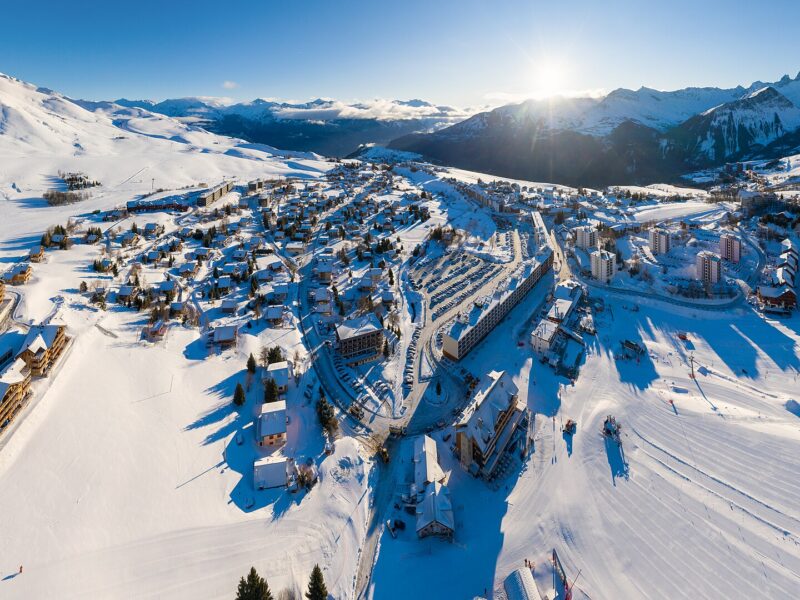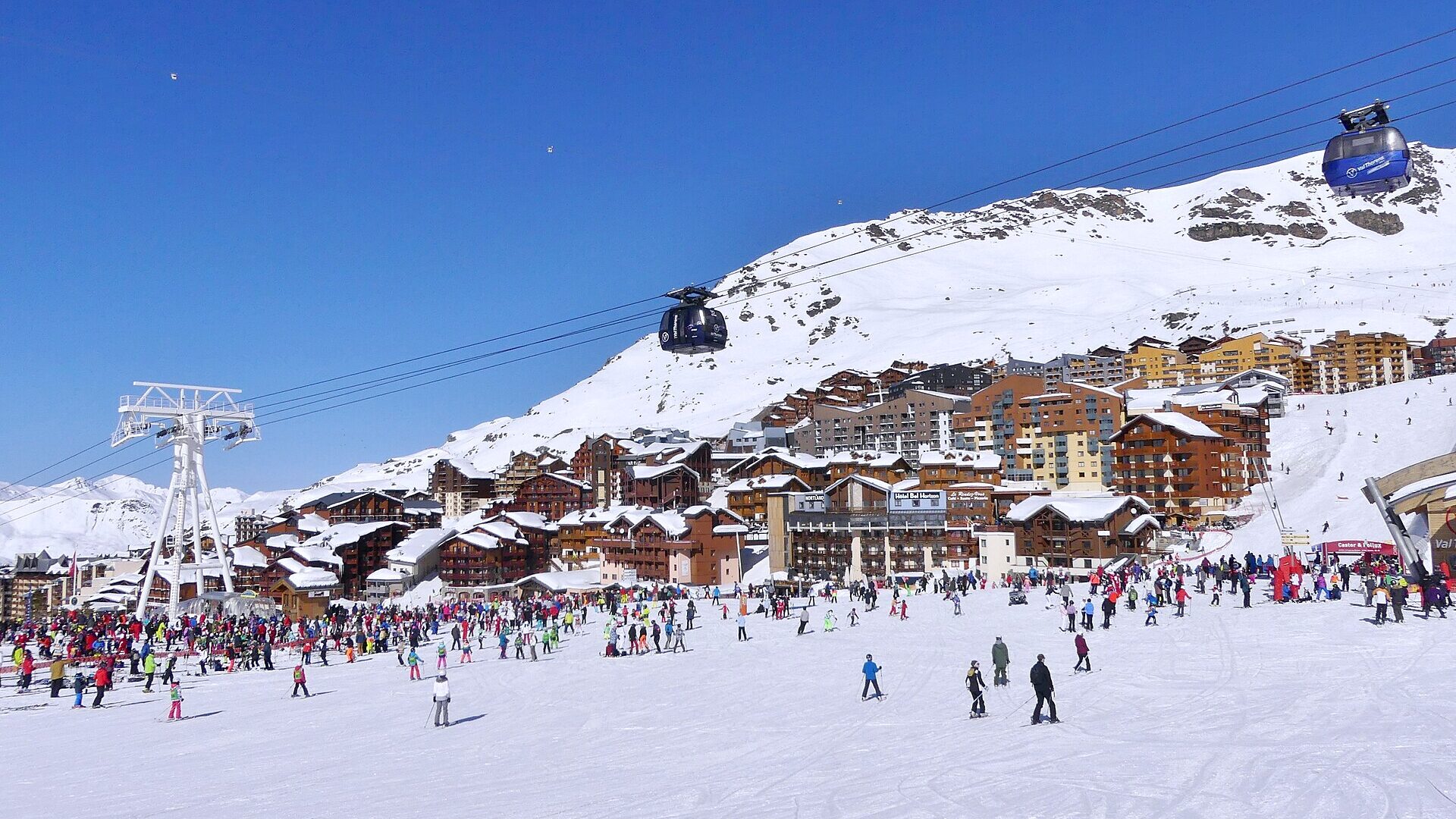

Val Thorens and Tignes are both purpose-built, high-altitude French resorts sold on guaranteed snow, but the numbers describe two different mountains. Val Thorens sits inside Les 3 Vallées, a 600 km linked area with 166 lifts, and its single day pass already covers the whole network for €84.2 (2026/27). Tignes shares the smaller, 300 km Espace Killy with Val d’Isère, and its €68 (2025/26) day pass buys only its own 150 km sector, not the whole area. Val Thorens is the higher resort at village level, with a base of 2,300 m against Tignes’ 1,550 m, but Tignes reaches further into the sky at the top, with its Grande Motte glacier taking the lift network to 3,456 m against 3,230 m at Val Thorens. Choose Val Thorens for snow at the front door and a pass that fully unlocks the largest linked area in our French data; choose Tignes for a much bigger vertical drop, a longer season and a cheaper headline price, on the understanding that price covers only Tignes’ own sector.
Key takeaways
- Val Thorens (Les 3 Vallées): 600 km, 166 lifts, 2,300 to 3,230 m, day pass €84.2 (2026/27) covers the whole linked area.
- Tignes (Espace Killy, shared with Val d’Isère): 300 km, 79 lifts, 1,550 to 3,456 m, day pass €68 (2025/26) covers only the local 150 km sector.
- Vertical drop: 1,906 m at Tignes against 930 m at Val Thorens, though Val Thorens’ 2,300 m base is 750 m higher than Tignes’.
- Difficulty split: Val Thorens 56% easy, 34% intermediate, 10% expert; Tignes 24% easy, 47% intermediate, 29% expert.
- Season in our data: Val Thorens November to May, Tignes October to May. Both plan to open on 21 November 2026.
- Pass cost per kilometre actually covered: €0.14 at Val Thorens against €0.45 at Tignes.
Val Thorens vs Tignes: the numbers side by side
| Val Thorens | Tignes | |
|---|---|---|
| Linked ski area | Les 3 Vallées | Espace Killy (with Val d’Isère) |
| Total slopes (linked area) | 600 km | 300 km |
| Own sector | 150 km | 150 km |
| Easy | 336 km (56%) | 72 km (24%) |
| Intermediate | 204 km (34%) | 140 km (47%) |
| Expert | 60 km (10%) | 88 km (29%) |
| Lifts | 166 | 79 |
| Km of piste per lift | 3.6 km | 3.8 km |
| Base to top | 2,300 to 3,230 m | 1,550 to 3,456 m |
| Vertical drop | 930 m | 1,906 m |
| Snow parks | 3 | 3 |
| Season (our data) | November to May | October to May |
| Planned opening 2026/27 | 21 November 2026 | 21 November 2026 |
| Adult day pass | €84.2 (2026/27) | €68 (2025/26) |
| Pass covers | Whole 600 km Les 3 Vallées | Own 150 km sector only, of 300 km Espace Killy |
| Pass cost per km covered | €0.14 | €0.45 |
| Nearest airport | Chambéry, about 67 km | Turin, about 65 km |
| Intski flags | Snow-sure, après-ski, modern lifts, scenic | Snow-sure, modern lifts, off-piste |
Source: Intski resort database and lift pass index, checked 19 September 2026. Airport distances are straight-line. Slope kilometres for the linked areas are as published by the resorts.
Altitude: two different ways to be snow-sure
Val Thorens is the highest resort in our data, with skiing starting from a 2,300 m village and running to 3,230 m. That base is higher than the summit of most Alpine resorts, which is why Val Thorens can promise snow to the door from the start of the season. The trade-off is a modest vertical drop of 930 m within the resort itself.
Tignes starts far lower, at 1,550 m, but its lift network climbs to 3,456 m on the Grande Motte glacier, a vertical drop of 1,906 m, more than double Val Thorens’ figure. That glacier is why our data tags Tignes for glacier and year-round skiing; Val Thorens has no glacier in our data, and its snow-sure reputation rests on altitude alone. See our guide to vertical drop in skiing for why the base-to-top figure matters.
Terrain size and difficulty split
Les 3 Vallées is the area Val Thorens skiers actually experience: 600 km and 166 lifts, shared identically with Courchevel, Méribel and the valley’s other resorts, because the figures describe the whole connected network. Val Thorens’ own sector is 150 km, the same as Tignes’ own sector within the smaller Espace Killy, which totals 300 km and 79 lifts, split evenly between Tignes and Val d’Isère at 150 km each.
The difficulty split favours Val Thorens for easy terrain and Tignes for expert terrain, in percentage terms. Les 3 Vallées is 56% easy, 34% intermediate and 10% expert. Espace Killy is 24% easy, 47% intermediate and 29% expert, identical for Tignes and Val d’Isère since they share the same figures. In absolute kilometres the gap is wider still: 336 km of easy piste against 72 km, because Les 3 Vallées is both twice the size and graded far more generously.
Lifts and how the two areas are built
Les 3 Vallées runs 166 lifts across its 600 km, or one lift for every 3.6 km of piste. That count reflects a valley linking five main resorts, Val Thorens, Les Menuires, Saint Martin de Belleville, Méribel and Courchevel, so many lifts connect one sector to the next rather than opening new terrain. Espace Killy has 79 lifts on 300 km, one for every 3.8 km, a similar density built around just two resorts. Both figures sit close to the two-to-five-km-per-lift range our St Anton vs Ischgl comparison found typical in the Alps.
Season and opening dates
Val Thorens’ season in our data runs November to May, and the resort has announced its opening weekend, La Grande Première, for 21 and 22 November 2026, with lifts running from the Saturday morning. No closing date had been published when we checked. Tignes runs October to May in our data, with a planned opening of 21 November 2026 and a planned closing of 2 May 2027, one of the longer seasons in the French Alps. Val d’Isère, sharing the same lift network, has a slightly later planned opening of 28 November 2026. Check our opening dates page for the current status of both resorts before you book.
Price and what the pass actually covers
Val Thorens’ adult day pass is €84.2 for 2026/27, up from €81.8 in 2025/26, a rise of about 2.9%. That price buys the “linked” Les 3 Vallées pass, the full 600 km at every lift in the valley, for one price. Divided across the area it unlocks, that is €0.14 per kilometre, good value for the size of the area.
Tignes’ adult day pass was €68 in 2025/26, with the 2026/27 price not yet published. Its scope is “local”: the pass covers Tignes’ own 150 km sector, not the wider 300 km Espace Killy. Skiers who want Val d’Isère on the same ticket should check current pass options directly, since our database has no combined Espace Killy price. Measured against the terrain it covers, the Tignes pass works out at €0.45 per kilometre, over three times Val Thorens’ figure. The gap says less about which resort is “expensive” than about what each price buys: a full 600 km network at Val Thorens, a 150 km sector at Tignes. See the rankings for how both compare across Europe.
Getting there
Val Thorens’ nearest airport in our data is Chambéry, about 67 km away as the crow flies. Tignes’ nearest airport is Turin, about 65 km away as the crow flies, a reminder that this corner of the Alps sits close to the Italian border. Straight-line distance is not transfer time on mountain roads, so treat both as a rough guide, and run the full trip cost through our ski trip cost calculator.
Which resort suits you
- Guaranteed snow with the shortest possible walk to the lifts: Val Thorens. A 2,300 m base beats anything a lift system has to climb to reach at Tignes.
- The biggest vertical drop and glacier skiing: Tignes. 1,906 m of descent and a glacier sector that our data tags for year-round skiing.
- The largest area a single pass fully unlocks: Val Thorens. €84.2 buys every lift across 600 km, with no local-only catch.
- Best value for the terrain the pass actually covers: Val Thorens, at €0.14 per km against €0.45 at Tignes.
- A slightly steeper terrain split and an off-piste flag: Tignes, at 29% expert against Val Thorens’ 25%.
- Longest season and earliest confirmed opening: Tignes, October to May with lifts running from 21 November 2026.
- Two resorts on one lift network without changing hotel: Tignes, sharing Espace Killy with Val d’Isère.
Put your own priorities into the compare tool to weigh altitude, price and terrain side by side. Official sites: Val Thorens and Tignes.
Quick answers
Which is bigger, Val Thorens or Tignes?
Val Thorens, if you count the whole linked area each pass covers. Les 3 Vallées, Val Thorens’ network, has 600 km of piste and 166 lifts. Espace Killy, shared by Tignes and Val d’Isère, has 300 km and 79 lifts. Each resort’s own sector is 150 km.
Is Val Thorens higher than Tignes?
At village level, yes: Val Thorens’ base is 2,300 m against Tignes’ 1,550 m. At the top of the lift system it reverses: Tignes’ Grande Motte glacier reaches 3,456 m, higher than Val Thorens’ 3,230 m summit.
Which has the longer ski season?
Tignes, running October to May in our data with a planned opening of 21 November 2026. Val Thorens runs November to May and plans to open on the same day, 21 November 2026.
Which is cheaper, Val Thorens or Tignes?
By headline price, Tignes: €68 (2025/26) against Val Thorens’ €84.2 (2026/27). But the Tignes pass only covers its own 150 km sector, while the Val Thorens pass covers the full 600 km Les 3 Vallées. Per kilometre actually covered, Val Thorens is far cheaper at €0.14 against €0.45.
Does the Tignes lift pass cover the whole Espace Killy area, including Val d’Isère?
Not according to our data. Tignes’ day pass is scoped “local” and its listed coverage is 150 km, half of the 300 km Espace Killy area it shares with Val d’Isère. Check current pass options directly with the resort if you plan to ski both villages.
Is Val Thorens or Tignes better for beginners?
Val Thorens has the gentler profile: 56% of Les 3 Vallées is graded easy against 24% of Espace Killy, and in absolute terms that is 336 km of blue piste against 72 km.
How far are Val Thorens and Tignes from the airport?
Val Thorens’ nearest airport is Chambéry, about 67 km away as the crow flies. Tignes’ nearest airport is Turin, about 65 km away as the crow flies. Both figures are straight-line distances, not road transfer times.